
.svg)



Jointly-Owned Properties in Dubai: Investor Rights and Legal Protections
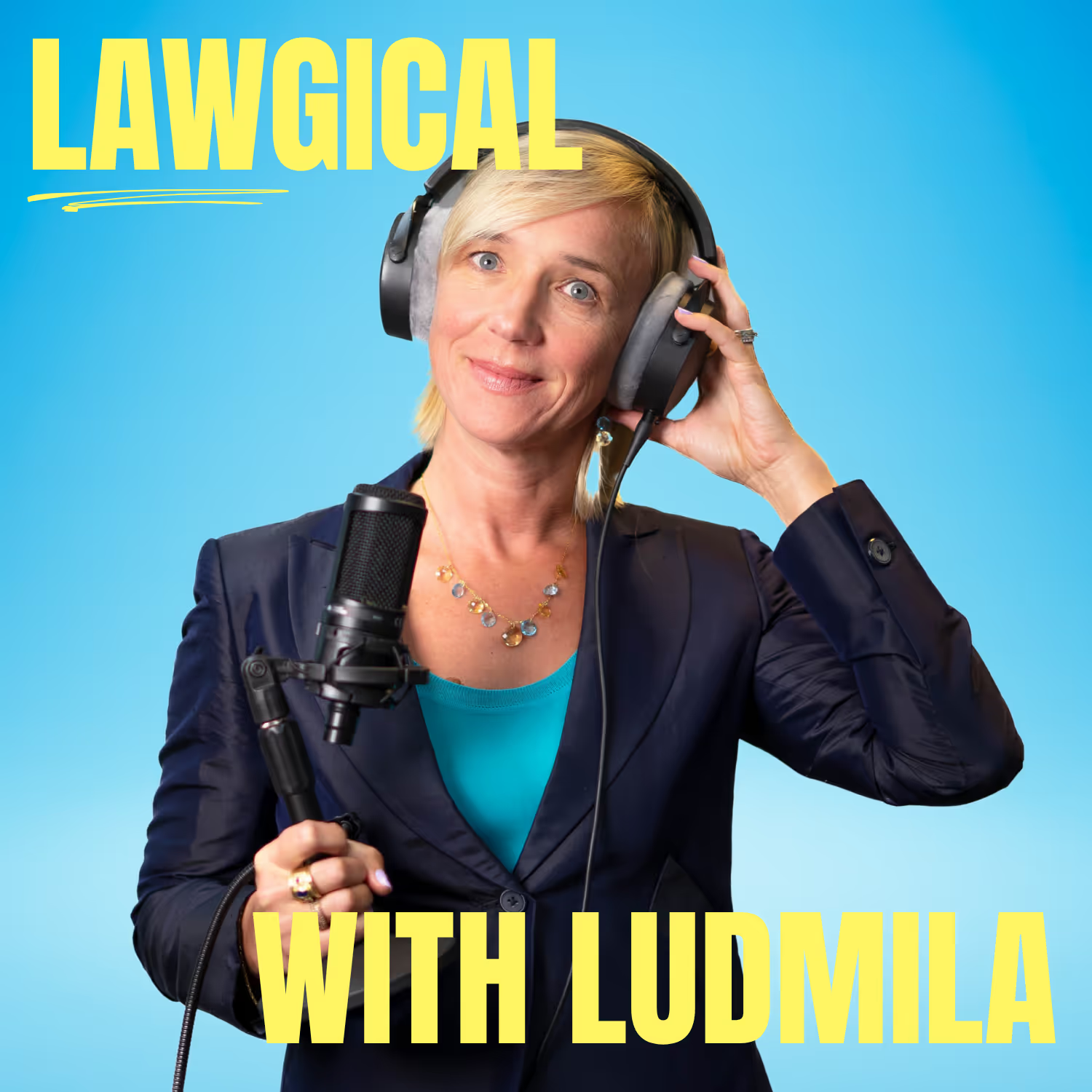
Who owns and controls the common areas of a jointly owned property in Dubai? What rights do individual property owners have, and what happens when they disagree with a developer or management company? In this episode of Lawgical, Ludmila Yamalova examines the legal framework governing jointly owned properties in Dubai. She explains how the UAE Constitution, the UAE Civil Transactions Law, Dubai real estate laws, the Eight Principles of Dubai, and RERA regulations collectively shape the rights and protections available to property owners and investors.
The episode also explores the roles of owners’ committees, management companies, developers, the Dubai Land Department and RERA. It considers recurring concerns involving service charges, access to financial records, conflicts of interest, management-company performance and the limited legal standing currently available to owners’ committees. Topics covered include:
- What constitutes jointly owned property in Dubai
- Ownership of common areas and undivided shares
- The hierarchy of federal and Dubai real estate laws
- The relevance of the Eight Principles of Dubai
- The roles of the Dubai Land Department and RERA
- The rights and responsibilities of property owners
- The function and limitations of owners’ committees
- The role of developers following property handover
- Service charges, audited budgets and segregated accounts
- Conflicts of interest involving management companies
- The process for replacing a management company
- The jurisdiction of the Rental Disputes Center
- Complaints involving government authorities
- The legal remedies available when owners’ concerns remain unresolved
The central principle is that owners hold genuine interests in the common parts of their communities and should be able to manage those interests collectively. Management companies act as service providers, while regulators and legal procedures are intended to protect property ownership, investor confidence and the integrity of Dubai’s real estate market.
Welcome back to Lawgical with Ludmila, where we untangle the legal knots so that you don't have to. I'm Ludmila Yamalova, a U.S.-qualified lawyer based in Dubai. In each episode, we break down complex legal issues into clear, practical insights that you can actually use.
In today’s episode, we are going to discuss jointly owned properties, primarily in Dubai and, to some extent, across the UAE. By jointly owned properties, I mean towers, villa communities, master communities and other developments in which multiple investors own property. One question sits beneath almost every dispute in these communities: Who owns the property, who has the right to manage it, and which rights attach to each part?
There continues to be considerable confusion surrounding this issue. Many investors are unsure about the rights they have in jointly owned communities, the rights they do not have and how their communities should be managed. In particular, there is confusion about:
- The role of management companies
- The continuing role of developers
- The role of the Real Estate Regulatory Agency, or RERA
- The role of the Dubai Land Department, or DLD
- Who these authorities represent when disputes arise
- Who owns and manages the common parts of a community
A further complication is that relatively few of these disputes reach the courts. As a result, we do not yet have a comprehensive body of judicial decisions interpreting all the legal authorities that govern jointly owned properties and communities. Many of the issues we will discuss have not yet been conclusively settled by the courts.
For present purposes, we are speaking primarily about Dubai rather than the UAE as a whole. The associations or communities that are supposed to govern jointly owned properties do not currently have legal standing to file court cases in their own names. For example, if a community has a dispute with its management company, developer, service provider or another third party, the community does not presently have the legal capacity to file a court case in the name of the community. Instead, it remains dependent on third parties or individual owners, which we will discuss shortly.
In this episode, we will examine the legal framework governing jointly owned properties and identify the issues that commonly arise. Court interpretation in this area continues to evolve. The purpose of this episode is therefore to:
- Outline the applicable legal framework.
- Explain the legal foundation governing jointly owned properties.
- Identify the issues and disputes that commonly arise.
- Examine how those disputes are currently being addressed.
- Consider the extent to which these disputes are still being adjudicated.
- Identify the arguments that jointly owned communities may rely on before judicial and government authorities.
This is not a simple subject, but it is an important one. There are many jointly owned communities in Dubai, and several unresolved issues remain. My objective is to give people living and investing in these communities a toolkit of legal rights and authorities that they can rely on to understand their position, advocate their cause and protect the interests of their community. There are uncertainties, areas of confusion and ongoing disputes. Nevertheless, from a legal standpoint, there is a substantial body of authority on which owners and investors can rely.
The purpose of this episode is to help you understand the legal rights and resources available if you face an issue as a resident, property owner or investor in a jointly owned community. The law, legal practice, communities and Dubai’s real estate market continue to develop. As the relevant laws are implemented and cited more frequently, we can expect this area of law to become more established and settled.
It is important to remember that the UAE is still a relatively young country. When we consider the country’s short history and the extraordinary pace of its progress, particularly over the past twenty years, it is understandable that some areas of law and practice remain under development. Confusion naturally arises whenever new legislation is introduced or an economy and society evolve. However, the UAE has a proven record of adapting quickly and implementing new laws. Implementation usually follows legislation. There is inevitably a period during which new laws must be understood, interpreted and properly incorporated into practice. That happens everywhere, although the process often moves much faster in the UAE.
The Legislative Framework
The legal framework governing jointly owned property can be understood from the top down:
- UAE Constitution: Protects private property, restricts confiscation and establishes the supremacy of federal law.
- UAE federal law: Defines ownership and provides that co-owners manage co-owned property collectively.
- Dubai laws and principles: Regulate Dubai’s real estate market, DLD, RERA, property registration and the jointly owned property regime.
- Circulars and operational rules: Establish procedures, forms, timelines, service-charge controls and owners’ committee processes.
Let us now examine this legislative framework. This discussion contains a little more legal terminology, but that detail is important because so many of us in the UAE live in jointly owned communities.
We understand the practical reality of having an access card, paying service charges, receiving Mollak statements, registering complaints and experiencing maintenance or neighbouring-property issues. We interact with jointly owned communities daily. However, when a dispute arises, relatively few people understand which legal instruments and procedures they can use to advocate their position. That is why this episode contains more legal detail. The legal framework provides the foundation on which arguments can be made.
The Hierarchy of Applicable Laws
Real estate matters in the UAE are generally regulated at the level of the individual emirate. Dubai, Abu Dhabi, Ras Al Khaimah, Fujairah and the other emirates have their own real estate laws. However, these laws do not stand alone. They operate within a broader hierarchy. Every lower-level law, regulation or rule must conform to the legal authority above it. Real estate laws are issued at the level of an individual emirate. Consequently, they remain subordinate to higher federal laws.
At the top of this hierarchy is the UAE Constitution. The Constitution is the principal source of protection for private property and the rights attached to it. Below the Constitution sits UAE federal law. This differs from the real estate laws issued by Dubai or another individual emirate because federal law applies across all emirates. One of the most relevant federal laws is the UAE Civil Transactions Law. It sits below the Constitution but above emirate-level real estate legislation. The Civil Transactions Law was recently updated and came into effect in 2026. I recorded a separate podcast about it for those who want a more detailed explanation.
For today’s purposes, the Civil Transactions Law is important because it defines what ownership of private property means. Below the federal legislation sit the real estate laws issued by the individual emirates. In Dubai, these include the Dubai real estate laws and an important instrument known as the Eight Principles of Dubai. These principles reflect the values and objectives established for the Emirate by the Ruler of Dubai.
The hierarchy can therefore be summarised as follows:
- The UAE Constitution
- UAE federal law, including the Civil Transactions Law
- The Eight Principles of Dubai
- Dubai real estate laws
- Circulars, decrees, bylaws and resolutions issued by the relevant government authorities
For jointly owned properties in Dubai, the principal government authorities are:
- The Dubai Land Department, or DLD
- The Real Estate Regulatory Agency, or RERA
Other emirates have their own corresponding authorities. The circulars, decrees and operational decisions issued by DLD and RERA must remain consistent with the higher laws above them. In simple terms, federal law prevails when local legislation conflicts with the Constitution or federal law. If a Dubai law or RERA circular conflicts with an overarching principle of federal law, the conflicting local provision may be superseded by federal law. Similarly, if a RERA circular contains uncertainty or ambiguity, it should be interpreted in accordance with the higher federal legal framework.
The Eight Principles of Dubai
The Eight Principles of Dubai are particularly interesting.
People who have recently travelled through Dubai’s airports may have noticed large displays setting out these principles. I decided to investigate whether they formed part of an actual official instrument. The Eight Principles of Dubai are contained in an official document issued through the Executive Office and signed by His Highness Sheikh Mohammed bin Rashid Al Maktoum. They are not merely inspirational statements displayed at the airport. They are an official expression of the legal, institutional and economic values that the Ruler of Dubai intends the Emirate to follow. For the purposes of legal substance and authority, I would argue that they constitute a relevant legal authority.
The Eight Principles of Dubai express, in comparatively plain language, many of the same ideas found within the broader hierarchy of UAE law. The first principle states that the Union, meaning the UAE federation, is the foundation. Federal law transcends local law. Accordingly, any law issued at the level of an individual emirate remains subordinate to federal law, particularly where there is a conflict, discrepancy or ambiguity. The Eight Principles also establish that no one is above the law. Justice is administered without distinction between:
- Citizens and residents
- Rich and poor
- Men and women
- Muslims and non-Muslims
The principles also state that justice delayed is justice denied. In the context of jointly owned properties, this means that if property-related issues are not addressed within a reasonable period, an argument may be made that justice is being delayed and, therefore, effectively denied. Other principles describe Dubai as a business capital whose continued success depends on:
- Credible government
- An active private sector
- A fair private sector
- An open private sector
- Continued economic growth
- Investor confidence
These principles establish the values through which Dubai’s lower-level laws, regulations and administrative decisions should be interpreted. The UAE Constitution, federal law and the Eight Principles of Dubai therefore operate as a filter through which the powers and responsibilities of DLD, RERA and other authorities should be understood.
The UAE Constitution
The UAE Constitution contains several provisions relevant to jointly owned property. For today’s discussion, three propositions are particularly important:
- The Constitution protects private property.
- It prohibits the confiscation of private property except in circumstances permitted by law.
- It confirms that federal law prevails over conflicting local law.
The relevant constitutional provisions include Articles 21, 39 and 151. These articles support the three propositions I have just outlined.
Article 21 protects private property. Any restriction on private property must be prescribed by law. A restriction that is not legally authorised cannot displace the protection afforded to private property. Deprivation of private property is only permitted in narrowly defined circumstances and must be accompanied by equitable compensation. The Constitution also establishes that confiscation is generally prohibited. The confiscation of specific property requires a judicial judgment issued in circumstances defined by law and accompanied by adequate compensation. These protections are important because all lower-level real estate laws, regulations and administrative decisions must be read consistently with the constitutional protection of property.
The UAE Civil Transactions Law
At the federal level, the relevant legislation is Federal Decree-Law No. 25 of 2025, the UAE Civil Transactions Law, which came into effect in 2026. The Civil Transactions Law is extensive and governs many aspects of everyday life in the UAE. For the purposes of this discussion, however, two principles are especially relevant:
- It defines the rights associated with ownership.
- It provides that co-owners manage co-owned property collectively.
Article 1036 states that ownership gives a person authority over property. The owner has the right to use, enjoy and dispose of the property as the owner considers appropriate. Article 1039 provides that no person may be deprived of property or its enjoyment except as permitted by law. Perhaps the most important provision for jointly owned properties is Article 1054(1). It provides that the management of co-owned property belongs to the co-owners collectively. The right to manage the property therefore belongs to the owners. It does not belong to:
- The management company
- The developer
- A regulatory authority
- Another third party
The management of co-owned property belongs collectively to the co-owners. This principle is important, instructive and decisive for the remainder of our discussion. It becomes the filter through which the lower-level laws, contracts and management arrangements should be understood. Contracts connected with the management of jointly owned properties must also be performed in good faith. Legal rights may not be abused or exercised:
- To harm other people
- Disproportionately
- In bad faith
- Contrary to public order
Accordingly, contracts involving management companies, developers, service providers and jointly owned properties cannot be performed in a manner intended to harm property owners or deprive them of the benefit of their property. These principles arise from Articles 246 and 106, among other related provisions of the Civil Transactions Law.
Dubai Laws and the Eight Principles of Dubai
At the Dubai level, we have the Eight Principles of Dubai followed by several specific laws governing the real estate sector. The relevant legislation includes:
- Dubai Law No. 7 of 2006
- Dubai Law No. 7 of 2013
- Dubai Law No. 4 of 2019
- Dubai Law No. 6 of 2019
These laws establish the legal framework for property registration, define the mandates of DLD and RERA, and regulate jointly owned properties. They also reflect the broader principle of equality before the law, which is reinforced by the Eight Principles of Dubai. Below these laws are numerous circulars, resolutions, decrees and administrative decisions. Those who visit the DLD and RERA websites will find dedicated sections containing these legal authorities. They establish the procedures, forms and timelines used to manage real estate matters in Dubai. However, all these circulars, resolutions and administrative decisions remain subordinate to the Constitution, federal law and the Dubai legislation above them.
Three Governing Principles
Reading the legal hierarchy from the top down gives us three governing principles:
- Protect investors.
- Build and maintain the Dubai brand.
- Allow owners to govern the property they collectively own.
Everything else should be interpreted in accordance with these principles.
Principle One: Protect Investors
The Constitution protects private property, federal law gives ownership its substance, and DLD and RERA were established to protect investors and regulate the market. Therefore, investor protection is the first governing principle.
Principle Two: Build and Maintain the Dubai Brand
The second principle is to build, maintain and enhance the Dubai brand. Dubai is positioned as a business capital whose prosperity depends on credible government and an active, fair and open private sector. Investor confidence is one of the most important products of this system. The objective is not merely to preserve Dubai’s existing real estate market. It is to continue developing Dubai as a world-class jurisdiction and an international model for real estate investment.
Principle Three: Owners Govern Their Property
The third principle, specifically in the context of jointly owned property, is that owners govern the property they collectively own. This follows directly from federal law, which provides that the management of co-owned property belongs to the co-owners collectively. Regulation must support that principle. It should not replace it, undermine it or take the right of management away from the owners. The applicable regulations should strengthen the owners’ ability to govern their property and bring that legal principle to life.
The Role of the Dubai Land Department
The Constitution, federal law and the Eight Principles of Dubai act as a filter through which we should interpret the authority of the Dubai Land Department. The DLD’s mandate, as stated in the law, is to create a world-class, pro-investment real property environment in Dubai. Among other things, the DLD must:
- Encourage real estate investment
- Create favourable conditions for investors
- Protect and stabilise the real estate market
- Raise awareness of the rights and obligations of market participants
These principles arise from Dubai Law No. 7 of 2013 concerning the Dubai Land Department, particularly Articles 5 and 6. In simple terms, this law established the DLD and defined its mandate. That mandate is not limited to encouraging people to invest in Dubai. It also includes protecting those investments and helping Dubai maintain a world-class real estate market.
The Role of RERA
Another important law is Dubai Law No. 4 of 2019 concerning the Real Estate Regulatory Agency, particularly Articles 4 and 5. This law establishes RERA and defines its mandate. RERA exists to provide a safe and supportive environment for real estate development and to protect both investors and developers. Its powers include:
- Licensing
- Monitoring
- Auditing
- Inspection
- Investigating complaints
- Regulating jointly owned properties
RERA acts as an operational arm of the broader regulatory system. It implements the overall mandate established for Dubai’s real estate market. Its role should therefore be understood through the principles we have already discussed: protecting private property, encouraging investment and supporting Dubai’s position as a global standard for real estate investment. RERA does not replace or override investors’ rights. Its role is to regulate the market in a way that serves and protects those rights.
Dubai Property Registration
Dubai Law No. 7 of 2006 concerning real property registration is also relevant, particularly Articles 7 and 24. This law establishes the property register through which title deeds are registered.
The property register is treated as conclusive. Title deeds carry significant evidentiary value and may generally only be challenged in exceptional circumstances, such as fraud or forgery. A title deed therefore serves as conclusive evidence of ownership, subject to the exceptions provided by law. However, constitutional protection cannot be confined to simply having a person’s name on a title deed. Meaningful ownership must include the ability to:
- Possess the property
- Use the property
- Enjoy the property
- Protect the property
- Exercise the rights associated with the property
Merely appearing on a title deed does not make ownership meaningful if the owner cannot exercise the substantive rights that ownership is supposed to provide.
Dubai Law No. 6 of 2019
Jointly owned property in Dubai is principally governed by Dubai Law No. 6 of 2019. Under Article 11, each owner holds an undivided share in the common parts of the property. Imagine a building containing one hundred units. Each owner holds an undivided interest in the common areas, which may include elevators, hallways, elevator shafts, parking areas, lobby, shared grounds, common facilities, and other similar areas.
These areas are not owned by an unrelated third party. They are owned collectively by the property owners. The size of each owner’s share generally corresponds to that owner’s interest in the community. The same principle applies to a community containing several buildings. Anything legally classified as a common part is, by definition, held collectively by the owners.
Service Charges and Approved Budgets
Dubai Law No. 6 of 2019 also regulates service charges and the entities responsible for managing jointly owned properties. A management company cannot collect service charges without an approved and audited budget.
The law imposes a structured framework governing how management companies collect service charges on behalf of and for the benefit of property owners. The budget must be approved by RERA and must also be audited. It is not sufficient for the management company merely to prepare and present a budget. These requirements are intended to protect property owners.
Segregation of Owners’ Funds
Another protection is that owners’ funds must be held in a segregated account.
The account may be administered by the management company, but the funds cannot be mixed with the management company’s own money or other accounts. The funds may only be used for purposes connected with the community. They should also remain protected from the management company’s creditors. In practice, the account operates similarly to a segregated escrow account.
RERA’s Oversight Role
Under the law, RERA has an oversight role. Its responsibilities include the authority to:
- Inspect records
- Audit financial information
- Monitor service charges
- Direct repairs
- Investigate complaints
- Oversee the management of common parts
- Take action when a management company fails to perform its duties
These powers are intended to protect property owners, not to obstruct or delay them.
Replacement of an Incompetent Management Company
Dubai Law No. 6 of 2019 also provides that a management company may be replaced if it is incompetent, unqualified or unable to manage and maintain the common parts. This follows logically from the protection afforded to private property.
If owners collectively own the common parts and a company manages those parts incompetently, the owners must have an avenue through which they can seek the company’s replacement. Otherwise, the owners may be denied the full benefit of their property. That would conflict with the protections contained in the Civil Transactions Law and the UAE Constitution.
Jurisdiction of the Rental Disputes Center
Disputes involving jointly owned properties and management companies fall within the jurisdiction of the Rental Disputes Center, or RDC. The name can be confusing because the RDC is usually associated with landlord-and-tenant disputes. However, Dubai Law No. 6 of 2019 specifically gives the RDC jurisdiction over certain jointly owned property matters. Article 42 addresses this jurisdiction. This means that although the dispute may not involve a traditional rental relationship, the law may still require the parties to bring the matter before the RDC.
Penalties for Violations
Violations of the jointly owned property legislation can result in significant penalties. Depending on the relevant violation, a fine may reach AED 1 million. For repeated offences, the fine may be doubled to AED 2 million. These penalties may apply to management companies or other regulated entities that violate their legal obligations.
The existence of these penalties reinforces the point that the duties imposed by the jointly owned property legislation are substantive legal obligations. They are not merely recommendations.
RERA Circulars and Operational Rules
Below the principal legislation are RERA’s circulars and operational rules. These circulars provide more detailed procedures governing the administration of jointly owned properties.
One of the more recent instruments discussed in this episode is RERA Circular No. 26 C03, concerning owners’ committees and issued in 2026. Among other things, the circular provides that the Mollak system serves as the official record for owners’ committee meetings and votes. Accordingly, when an owners’ committee meets and makes decisions, those meetings, votes and decisions should be recorded through the Mollak system. The circular also establishes the principle of one member, one vote.
In addition, it sets out a staged process for replacing a management company. It also provides for immediate replacement in cases involving proven, serious financial violations. If a management company is responsible for a serious financial violation, the circular recognises that immediate replacement may be justified. This is addressed in Article 9.
Most importantly, the circular must be interpreted in light of Dubai Law No. 6 of 2019, including Article 19. This takes us back up the legal hierarchy. A circular must be interpreted consistently with the legislation above it and, ultimately, with the overarching objective of protecting investors. Other circulars have also been issued since 2019 concerning the establishment and operation of the Mollak system.
Another important instrument is RERA Circular No. 2 of 2020 concerning conflicts of interest involving jointly owned property management companies. Circular No. 3 of 2021 establishes mechanisms for collecting service charges and the procedures that must be followed before a dispute is referred to the RDC.
These circulars provide operational detail. However, they do not replace or override the higher legislation.
What the Legal Hierarchy Means in Practice
The hierarchy acts as a legal filter. DLD and RERA circulars, decrees, decisions, regulations and administrative orders must be read through the laws and principles above them. Their powers must serve the statutory purpose for which they were granted. The powers provided under Dubai Law No. 4 of 2019 and Dubai Law No. 6 of 2019 should therefore be interpreted as instruments of investor protection, not as limitations on investors’ rights.
For example, RERA’s role in approving service charges is intended to protect owners from charges that have not been properly audited or authorised. This authority should not be used as a tool to delay budgets that communities need to operate. RERA must ensure that:
- Service charges are properly audited.
- Charges are supported by approved budgets.
- Owners are protected from unauthorised charges.
- Management companies comply with their legal obligations.
- Communities can access the funds necessary for proper maintenance and operation.
Similarly, RERA’s authority to enforce the duties of management companies must be exercised when owners raise legitimate complaints. RERA should use its powers to hold management companies accountable. Those powers should not be withheld from the owners whom the legislation is intended to protect.
If the owners of a jointly owned property demonstrate that their management company is failing, RERA’s role is to enforce the owners’ interests. In practical terms, that may mean replacing a management company that does not serve those interests.
Article 38 provides a remedy under which RERA may replace a failing management company. That remedy should be exercised promptly where there is a proven record of failure. It should not be deferred indefinitely. This takes us back to the Eight Principles of Dubai and the statement that justice delayed is justice denied. If owners have demonstrated that a management company is failing, yet the company is not replaced for an extended period, the delay may effectively deny justice to those owners. Such an outcome would conflict with the Eight Principles of Dubai and the protection of private property under the UAE Constitution.
The Role of Owners’ Committees
The law also establishes owners’ committees. The purpose of an owners’ committee is to give owners a voice and ensure that their recommendations carry meaningful weight. The committee should communicate the views and concerns of the wider community. Its role should not be reduced to a purely symbolic one. The committee must be able to:
- Present recommendations
- Communicate owners’ concerns
- Request relevant information
- Participate in decisions affecting the community
- Have its recommendations properly considered
- Represent the broader sentiment of property owners
RERA’s role in establishing and supervising owners’ committees should ensure that these committees can communicate effectively rather than silencing or restricting them. The overarching principle is that RERA regulates jointly owned property in the interests of investors and property owners. It does not own their property or replace their underlying rights.
The Role of Management Companies
The same legal hierarchy applies to management companies and developers. A management company is an appointed service provider. That description is important: it is a service provider to the community. The management company does not own the community and does not possess sovereign authority over it. Its role is to enforce the community’s legally established rules. It does not independently legislate or create new rules.
If community rules need to be changed, the management company may work with the owners, but the decision must be made through the appropriate legal and community processes. The management company’s authority is defined and limited by:
- The applicable legislation
- RERA’s regulations
- The community’s governing documents
- Its management agreement
- The duties it owes to property owners
Its powers are not unlimited or entirely discretionary. A management company’s duties are owed to the owners for whose benefit it provides its services. Those duties are owed to the owners collectively. A management company should not segregate owners or provide preferential treatment to one group of owners over another. At a high level, the management company performs a fiduciary function. It is not a sovereign authority. It is a service provider entrusted with responsibilities and funds for the benefit of the owners it serves.
The Role of Developers
The same legal filter applies to developers. Once the units have been handed over, the developer’s role in the common parts becomes limited to the authority specifically preserved by law. The precise extent of that role may depend on whether the development falls within Category 1, 2 or 3.
In certain Category 1 developments, for example, the developer may continue to manage common facilities. Outside the roles preserved by law, once the developer sells the units, its interest in the jointly owned property generally remains only to the extent that it continues to own unsold units. The developer does not remain the overarching owner of the entire community merely because it originally developed the project.
Like any other owner, its rights should correspond to the units or interests it continues to own. The developer should not occupy a seat on the owners’ committee unless it retains a qualifying ownership interest, such as unsold units, or the law otherwise preserves a specific role for it.
Recurring Problems in Jointly Owned Communities
Why are we discussing this today? There is growing concern among property owners who want their communities to be governed and managed more effectively. Several recurring problems appear across jointly owned communities, regardless of where the community is located.
Lack of a Separate Legal Entity
One of the most fundamental issues is that owners do not currently have a separate legal entity through which they can act collectively.
Many disputes and complaints might already have been resolved if owners’ committees, or the owners of jointly owned properties collectively, had the legal capacity to act as an association. At present, that option is not fully available. As a result, many issues have not been conclusively resolved by the courts. Although the legislative foundation exists, its interpretation through judicial forums remains a developing area of practice.
For the time being, owners generally cannot bring cases collectively in the name of an owners association. Instead, they may have to bring claims as individual owners. This can be both inefficient and ineffective.
For example, imagine a community containing one hundred property owners. The community itself may not have the legal standing to bring a case on its own behalf. Instead, the one hundred owners may have to pursue their claims individually. That creates an obvious practical difficulty.
Conflicts of Interest
Another recurring concern is the potential for conflicts of interest. Management companies may not always see eye to eye with private property owners, particularly in mixed-use communities involving:
- A hotel operator
- A master community
- A developer
- Commercial property owners
- Residential property owners
- Several entities with competing interests
The management company often controls the community’s records, accounts, funds and operational information. At the same time, those same records may be used to evaluate the management company’s performance while the company is defending its own appointment. This can create a conflict of interest.
If owners want to raise a complaint or address a particular issue, they may depend on the management company to provide the information necessary to support their case. That places the owners in a difficult position, particularly when the complaint concerns the management company itself. Some owners also feel that management companies operate communities as though they own them. They may believe that decisions are being made for the benefit of the management company, developer or another third party rather than for the benefit of the property owners.
The law establishes the opposite principle. A manager may not prevent an owner from using the owner’s unit or the common parts, except where a lawful restriction applies. Nevertheless, owners may feel that they are treated as subjects rather than principals within their own communities and that their interests are subordinated to those of other parties. This conflicts with the legal principle that the manager exists to serve the owners and must not deprive them of the proper use and enjoyment of the common parts.
Owners Feeling Unheard
Another frequent complaint is that property owners feel unheard. Owners’ committee meetings may not be held regularly. Requests for documents may not be answered promptly, and the information provided may be incomplete. Recommendations submitted by owners may not be properly considered or implemented. An owners’ committee cannot fulfil its purpose if it is not given:
- Regular opportunities to meet
- Access to relevant records
- Complete financial information
- An effective channel for submitting recommendations
- Meaningful responses to its concerns
- A role in decisions affecting the community
The committee exists to communicate the interests of the owners. It should not be reduced to a procedural formality.
Service-Charge Disputes
Service charges are another major source of disputes. Common complaints include:
- Service charges based on an unapproved budget
- Charges calculated using an incorrect unit area
- Common charges being mixed with unit-specific utilities
- Charges that are not adequately documented
- Amounts that have not been properly audited
- Expenses that do not appear to benefit the community
- Charges imposed without sufficient transparency
Some service-charge disputes have reached the Rental Disputes Center because they relate to specific units and the amounts charged to individual owners. For example, an owner may believe that service charges relating to the owner’s unit have been mixed with unrelated costs or calculated incorrectly. The judicial interpretation of these issues is continuing to develop.
Lack of Financial Transparency
Another concern is the lack of transparency surrounding community accounts. Because the management company administers the community’s finances, owners may not have direct access to information concerning:
- Service-charge collections
- Escrow or segregated accounts
- The amount of money held in reserve
- How community funds are being spent
- Contracts with service providers
- The tendering and bidding process
- The selection of contractors
- Payments made from community funds
This takes us back to the earlier issue concerning the legal standing of owners’ committees. Owners’ committees do not currently have a fully independent legal identity through which they can enter contracts.
For example, if a community wants to appoint gardeners, pool-maintenance contractors, painters, insurers or other service providers, the contract generally cannot be entered directly between the service provider and the owners’ committee. Instead, the contract is entered into by the management company, which is expected to act on behalf of the owners. Where the management company and owners are aligned, this arrangement may operate without significant problems.
However, where owners believe that the management company does not properly represent them, the arrangement becomes more difficult. The management company enters contracts for the benefit of the community, while the owners funding those contracts may feel that they have little influence over:
- The selection of the provider
- The cost of the service
- The contractual terms
- The quality of the work
- The renewal or termination of the agreement
This can create an escalating conflict. The absence of an independent legal forum through which the owners can act collectively makes it more difficult for them to address these concerns.
Replacing a Management Company
What can the owners of a jointly owned property do if they are unhappy with their management company or believe another company could provide a better service?
Changing service providers is a normal part of competition, progress and commercial development. Legal advisers are also service providers. A client may work with the same legal adviser for many years and then decide to appoint somebody else because the client’s needs have changed or another provider offers a more suitable service. The same principle can apply to community management. A community may decide that a different provider offers better technology, greater transparency, more responsive communication, stronger financial controls, better maintenance, competitive pricing, and a greater overall experience.
Wanting to replace a service provider is not, by itself, unreasonable. The statutory provisions governing the replacement of management companies are relatively brief and require interpretation.
When RERA considers a management company incompetent, unqualified or unable to manage and maintain the common parts, RERA may appoint a replacement through the prescribed process. The outgoing management company must then hand over the relevant records, accounts and funds within thirty days. Although the statutory wording may not expressly state in every instance that RERA must replace the company, the provision should be interpreted within the wider legal hierarchy.
RERA’s role is to protect investors. Therefore, if there is sufficient evidence that a management company is incompetent and is harming the owners’ interests, the logical conclusion is that RERA should replace it. Otherwise, the regulatory system would not serve the investors whom the higher legislation is intended to protect. That would conflict with the Civil Transactions Law and the constitutional protection of private property.
The Replacement Process
The law does not contain an exhaustive public checklist explaining every step a community must take when applying to replace its management company. RERA has therefore established its own protocols and requirements. From what we have seen, the complete checklist is not necessarily published publicly. Instead, RERA may provide it to communities seeking to apply for a management-company replacement. In practical terms, the process involves the following steps:
- Documenting the alleged violations.
- Filing complaints through the jointly owned property portal.
- Adopting a formal resolution requesting termination or replacement.
- Allowing RERA to notify the management company.
- Giving the management company an opportunity to rectify the violation where appropriate.
- Appointing an approved auditor.
- Appointing a technical inspector or surveyor where necessary.
- Submitting the audit and technical reports directly to RERA.
- Recommending licensed replacement management companies.
- Obtaining a decision from the relevant management-company termination committee.
Documenting the Violations
The owners’ committee should begin by collecting and preserving documentary evidence of the alleged violations. Depending on the circumstances, this evidence may include:
- Financial records
- Approved and unapproved budgets
- Audit reports
- Service-charge statements
- Owners’ complaints
- Meeting records
- Mollak records
- Maintenance reports
- Safety reports
- Correspondence with the management company
- Correspondence with RERA
- Contracts with service providers
- Evidence of unresolved defects
- Evidence of conflicts of interest
The committee must then file the complaint through the appropriate RERA or jointly owned property portal. A formal resolution seeking the termination or replacement of the management company may also be required.
Warning and Rectification Period
After receiving the complaint and reviewing the documented violations, RERA may issue a written warning to the management company. The management company may then be given an opportunity to rectify the violation. The relevant rectification period may be fourteen days, depending on the applicable provision and the nature of the violation. This means that the management company does not necessarily receive an indefinite period in which to correct the problem.
Where the law provides fourteen days, the company has fourteen days to address the violation identified in RERA’s warning. However, the circulars also recognise that some serious financial violations may justify immediate replacement.
Recommending Alternative Management Companies
The owners’ committee may be required to recommend one or more alternative management companies. The proposed companies should be properly licensed and approved by RERA. The committee does not necessarily have unrestricted authority to appoint any company it chooses. Its recommendations must come from providers authorised to perform the relevant services. RERA can then consider those recommendations as part of the replacement process.
Independent Audit
An independent audit may be required. The auditor must be appropriately licensed and approved by RERA. The management company may be required to sign the relevant audit agreement within five working days and cooperate fully with the audit. The audit report must be submitted directly to RERA.
RERA may instruct the owners’ committee not to:
- Interfere with the audit
- Expand the scope of the report without approval
- Influence the auditor
- Share the report with the management company before RERA releases it
These restrictions are intended to preserve the independence and confidentiality of the process. The owners’ committee may then be asked to sign a declaration confirming:
- Receipt of the report
- The auditor’s independence
- The committee’s non-interference
- Payment of the auditor’s fees
Technical Inspection
In addition to a financial audit, RERA may require a technical inspection or survey. A technical inspector or surveyor may examine:
- The condition of the common areas
- Outstanding maintenance issues
- Structural concerns
- Safety procedures
- Mechanical and electrical systems
- Community facilities
- The quality of previous repair work
- Whether reserve funds are adequate for anticipated repairs
The inspector’s report should also be provided directly to RERA.
Decision by the Termination Committee
After receiving the evidence, audit report and any technical report, the management-company termination committee considers the application. The committee may:
- Approve the replacement
- Reject the request
- Give the management company an additional rectification period
- Request further evidence
- Require additional inspections or reports
This authority must be exercised consistently with the wider legislative hierarchy and RERA’s statutory mandate. The decision should ultimately serve the lawful interests of the property owners and investors.
Summary of the Replacement Procedure
If a community wants to replace its management company, it should:
- Document the violations.
- Submit the violations and formal request to RERA.
- Cooperate with the appointment of approved auditors.
- Arrange a technical inspection if required.
- Submit the reports directly to RERA.
- Propose one or more licensed alternative management companies.
- Allow RERA and the termination committee to review the evidence.
- Obtain a decision on whether the existing company should be replaced.
If the evidence establishes that the existing management company is failing, RERA should make a decision that protects the owners and considers an appropriate replacement.
Costs of the Replacement Process
The replacement process may involve significant costs. Auditors and technical surveyors are professionals performing substantial work. Their services must be paid for. Both the auditor and technical inspector may need to be licensed or approved by RERA. When an owners’ committee files a request to terminate or replace a management company, it may also need to request the appointment of these professionals. RERA may authorise their fees to be paid from the community’s service-charge funds. This is possible because the service-charge funds are held under RERA’s supervision.
With RERA’s approval, amounts owed to the audit company or technical inspector may be released from the community fund. We have seen those funds used for this purpose.
Timing and Practical Delays
One of the most significant practical concerns is how quickly replacement applications and owners’ complaints are considered. There are many jointly owned properties and communities in Dubai.
At present, much of the regulatory process ultimately leads back to RERA and the relevant committee within RERA. That is a relatively small administrative body compared with the number of communities it is expected to supervise. Delays may therefore be partly explained by:
- The volume of jointly owned properties
- The size of Dubai’s real estate market
- The number of complaints being submitted
- The complexity of individual communities
- The need for audits and technical inspections
- The limited number of representatives available to review cases
The more disputes that arise among jointly owned communities, the more work reaches RERA. That may explain some of the delays, but the legal framework remains important. The foundation exists to protect investors.
At every level, particularly at the constitutional and federal levels, the framework is built around the protection of private property and investment. Property owners should therefore understand that:
- Their underlying rights are legally protected.
- Specific laws exist through which those rights may be enforced.
- Particular forums have been established to address disputes.
- Lower-level rules must be interpreted through federal law and the Constitution.
- Administrative discretion is not above the law.
Meaningful Property Ownership
Constitutional protection cannot be confined to the name appearing on a title deed. Meaningful ownership must include the practical ability to:
- Possess the property
- Use the property
- Enjoy the property
- Protect the property
- Participate in its management
- Benefit from the owner’s share in the common parts
A title deed alone is not enough if the owner is prevented from exercising the substantive rights that ownership provides. Similarly, delays in addressing the concerns of property owners and investors may conflict with the principle that justice delayed is justice denied. RERA, DLD and other government authorities do not possess unlimited discretion. The Eight Principles of Dubai expressly provide that no one is above the law. Any discretion held by a government authority must therefore be exercised:
- Within defined legal limits
- Transparently
- For the statutory purpose for which it was granted
- With appropriate accountability
- Within a reasonable period
The laws exist to protect owners and should not be used against them.
A Clear Example
Consider a community whose records demonstrate:
- Several years of unapproved budgets
- Several years without audited accounts
- Depleted reserve funds
- Unresolved safety concerns
- Structural conflicts of interest
- Repeated complaints from owners
- Completion of all requirements imposed by RERA
In such a case, the reasonable legal outcome may be the prompt termination of the existing management company and the appointment of a qualified replacement proposed by the owners. That conclusion would be consistent with the legal authorities we have discussed.
These processes may take longer than owners would like. However, the purpose of understanding the legal framework is to give investors the tools to address their concerns using the correct legal resources and authorities available in the UAE.
Dispute Resolution Forums
Suppose a community has completed the required procedures, reviewed the relevant laws, submitted its evidence and made the necessary legal arguments, but the owners’ concerns are still not being addressed.
For example, the management company may not have been replaced despite the evidence presented by the owners. What can the owners do next? Several dispute-resolution forums may be available. The correct forum depends on the nature of the dispute, the parties involved and the location of the property.
Dubai Courts
The Dubai Courts generally hear property disputes that do not fall within the exclusive jurisdiction of another judicial body.
For example, suppose a person agrees to purchase a property, but the seller withdraws from the transaction. The buyer may believe that the buyer’s rights have been compromised and that expenses or financial losses have been incurred. That type of property dispute may be brought before the Dubai Courts, subject to the terms of the agreement and the particular facts of the case.
However, the Dubai Courts may not be the correct forum for disputes specifically concerning jointly owned properties and management companies.
Rental Disputes Center
Disputes concerning jointly owned properties and their management companies may fall within the jurisdiction of the Rental Disputes Center. Although the name suggests that the RDC only deals with traditional rental disputes, Dubai Law No. 6 of 2019 expressly gives it jurisdiction over certain jointly owned property matters.
The RDC may therefore be the appropriate forum for disputes involving:
- Service charges
- A management company
- The management of common parts
- Obligations imposed by jointly owned property legislation
- Claims concerning a specific property unit
- Other disputes assigned to the RDC under Dubai law
The existence of this jurisdiction is important because owners should not assume that every dispute involving property must automatically be filed before the Dubai Courts.
DIFC Courts
If the relevant property or dispute falls within the jurisdiction of the Dubai International Financial Centre, the DIFC Courts may be the correct forum. The DIFC has its own legal and judicial framework. Accordingly, a property dispute falling within DIFC jurisdiction would not necessarily be brought before the RDC or the ordinary Dubai Courts.
Arbitration
Arbitration may also be relevant where the applicable agreement contains a valid arbitration clause.
For example, an agreement between a management company, developer, master community or service provider may require disputes to be resolved through arbitration. In that situation, the wording and validity of the arbitration clause must be examined to determine:
- Which parties are bound by it
- Which disputes fall within its scope
- Which arbitral institution has jurisdiction
- Which procedural rules apply
- Whether the particular owner or community is a party to the agreement
Where a valid arbitration agreement covers the dispute, arbitration may be the appropriate forum.
Claims Against Government Authorities
A different procedure may apply if a community believes that RERA or DLD has failed to address its concerns properly or within a reasonable period.
For example, the community may have submitted substantial evidence against a management company and complied with all procedural requirements, but no effective decision has been made. In such circumstances, there is a specific legal route for bringing claims involving Dubai government entities.
I understand that the idea of filing a complaint involving a government authority may make people nervous. However, it is part of Dubai’s established legislative framework and should not automatically be viewed as something to fear.
Dubai Legal Affairs Department
The Government of Dubai Legal Affairs Department, or LAD, is generally a mandatory preliminary step for certain claims brought against a Dubai government entity, including claims involving DLD or RERA. This procedure is established by law. It is not an informal or invented remedy. It is a specific legal process through which a person or entity that has a dispute involving a government authority may raise that complaint.
The relevant legislation discussed in this episode is Dubai Law No. 16 of 2025 concerning government claims, particularly Articles 5 and 26. In the context of jointly owned properties, a community may believe that the administrative channels provided by RERA or DLD have not addressed its concerns properly or promptly. In that situation, the next step may be to submit a complaint through the Legal Affairs Department and the applicable government-claims procedure.
This mechanism exists because Dubai’s legal framework recognises that concerns may occasionally arise regarding the conduct or decisions of government entities. The process provides a formal channel through which those concerns can be reviewed.
Government Accountability in Dubai
Over the years, there has been considerable public discussion about the standards expected from Dubai government institutions and officials. His Highness Sheikh Mohammed bin Rashid Al Maktoum and other members of Dubai’s ruling family have repeatedly emphasised the importance of government performance, accountability and service standards. Secret-shopper exercises and other review mechanisms have, in some instances, identified shortcomings in government services. Where deficiencies have been found, the response has often been swift.
The Legal Affairs Department should be understood within that broader framework of accountability. The available legal avenues exist so that concerns can be:
- Brought to the attention of the appropriate authority
- Reviewed independently
- Mediated where possible
- Settled amicably
- Referred to the competent judicial body where necessary
There is therefore no reason to assume that using an established complaint procedure is improper merely because the complaint involves a government authority. That is precisely why the procedure exists.
Procedure Before the Legal Affairs Department
The general procedure begins by filing the complaint with the Legal Affairs Department. The complaint should identify:
- The claimant
- The relevant government entity
- The nature of the dispute
- The legal and factual basis of the claim
- The steps already taken
- The remedy being requested
- The supporting documents and correspondence
After the complaint is submitted, it may be referred to the relevant government entity within five working days. The process then allows a period of approximately sixty working days for an amicable settlement. During that period, the Legal Affairs Department may attempt to:
- Clarify the dispute
- Obtain a response from the government entity
- Facilitate communication
- Mediate between the parties
- Explore a possible settlement
If no settlement is reached, the Legal Affairs Department may issue a certificate confirming procedural compliance. Once that certificate is issued, the claimant may proceed before the competent judicial body. Depending on the nature of the jointly owned property dispute, that judicial body may be the Rental Disputes Center.
In this sense, the Legal Affairs Department serves as a preliminary settlement and dispute-management body. The claimant first raises the concern with LAD. LAD then attempts to mediate or resolve the matter. If those efforts are unsuccessful, the claimant may proceed to the relevant judicial forum. This creates a transparent legal channel through which disputes involving government entities can move forward.
Key Takeaways
This is a substantial subject with a lot to absorb, but the principal points can be summarised as follows.
1. Owners Hold Genuine Interests in the Common Parts
The common areas of a jointly owned property are not owned by the management company. Property owners hold real, undivided interests in those common parts. Their ownership may extend to facilities such as elevators, hallways, lobbies, parking areas, shared grounds, common recreational facilities, and other areas legally designated for collective use. Although each owner’s share is undivided, it is still a genuine proprietary interest.
2. Owners Have the Right to Manage What They Own
Federal law provides that the management of co-owned property belongs to the co-owners collectively. Owners therefore have the right to participate in the management of the property they collectively own. That right may be exercised through the owners’ committee and the procedures established under Dubai’s jointly owned property legislation.
3. The Management Company Is a Service Provider
The management company acts as a service provider and agent for the community. It does not own the community and does not possess unlimited authority over it. Its role is to manage the common parts, enforce lawful community rules, administer approved service charges, maintain transparent records, safeguard owners’ funds, and act in the owners’ collective interests. It enforces the rules. It does not independently legislate new rules.
The management company must account transparently and must not conceal records from the owners it serves.
4. Management Has a Fiduciary Role
The management company’s role is fiduciary in nature. Its duties are owed to the owners collectively. It should not give preferential treatment to one category of owners or prioritise the interests of the developer, hotel operator, master community or another third party over the lawful interests of the property owners.
5. Owners’ Funds Must Be Protected
Service-charge funds must be administered in accordance with the law. They should be supported by an approved and audited budget, held in an appropriately segregated account, used only for legitimate community purposes, protected from the management company’s creditors, subject to RERA’s oversight, and accounted for transparently.
6. The Developer Generally Steps Back After Handover
After the units are handed over, the developer’s role in the common parts becomes limited to the authority specifically preserved by law. The developer may continue to hold rights corresponding to unsold units or a legally recognised management role in a particular category of development. However, it does not remain the overarching owner of the community merely because it originally developed the project.
7. RERA Regulates in the Owners’ and Investors’ Interests
RERA’s powers must be interpreted in accordance with its statutory purpose. Its role is to protect investors, monitor management companies, approve and audit service charges, investigate complaints, direct repairs, regulate jointly owned properties, and replace an incompetent management company where justified.
RERA’s discretion is limited by the law, transparency, accountability and the purpose for which its powers were granted.
8. Circulars Implement the Law
RERA circulars and operational rules implement the higher legislation. They do not replace or override the superseding regulatory framework. Any circular or administrative decision must be read through that legal hierarchy.
9. Owners’ Committees Must Have a Meaningful Voice
Owners’ committees exist to communicate the concerns and recommendations of property owners.
Their role should not be purely symbolic.
They should have meaningful access to:
- Meetings
- Voting procedures
- Community records
- Financial information
- Management-company performance information
- Complaint mechanisms
- The process for recommending a replacement management company
10. A Failing Management Company May Be Replaced
A management company that is incompetent, unqualified or unable to manage and maintain the common parts may be replaced.
The replacement procedure may require:
- Evidence of the violations
- A formal complaint
- A warning from RERA
- A rectification period where appropriate
- An independent audit
- A technical inspection
- Recommendations for licensed replacement companies
- A decision from the relevant termination committee
Serious financial violations may justify immediate replacement.
11. Owners Have Access to Dispute-Resolution Forums
Depending on the nature of the dispute, owners may have access to:
- The Rental Disputes Center
- The Dubai Courts
- The DIFC Courts
- Arbitration
- The Dubai Legal Affairs Department
- Other competent judicial or administrative bodies
If one regulatory channel does not produce a resolution, another legal route may be available.
12. No One Is Above the Law
The Eight Principles of Dubai state that no one is above the law.
Government authorities, regulators, management companies, developers and private parties must all exercise their powers within the legal framework.
Administrative discretion is not above the law.
13. Justice Delayed Is Justice Denied
The Eight Principles of Dubai also state that justice delayed is justice denied.
Where owners have documented serious violations and completed the procedures required of them, their complaints should be addressed within a reasonable period.
Prolonged inaction can undermine the substantive protection that the law is intended to provide.
Conclusion
Jointly owned properties in Dubai are governed by a hierarchy consisting of:
- The UAE Constitution
- UAE federal law
- The Civil Transactions Law
- The Eight Principles of Dubai
- Dubai real estate legislation
- RERA circulars and operational rules
This hierarchy has an overarching purpose: to protect investors and allow owners to govern the property they collectively own. RERA’s powers, the management company’s role, the developer’s continuing rights and every applicable circular must be interpreted through that framework. When they are not, disputes stall and owners may be deprived of the meaningful benefit of their property. When the laws are applied as intended, the outcome should be clearer.
The legal framework is designed to favour the protection of investors and private property. Dubai and the wider UAE have built their reputations on providing a world-class, pro-investment environment, protecting investors, maintaining credible institutions and transparent government, ensuring equality before the law, and upholding the principle that no one is above the law.
Investors in jointly owned properties should therefore understand that the law exists to protect their interests and that legal forums exist through which those rights may be enforced.
If a regulator does not act, procedures are available through the Dubai Legal Affairs Department and the competent judicial authorities. There is no need to be afraid of using the legal mechanisms specifically created for that purpose. The UAE legal system, and the Dubai legal system in particular, provides a substantial framework for protecting property owners and investors.
That's all for this episode of Lawgical with Ludmila. If you found this discussion helpful, you can find more legal resources on our website, lylawyers.com. You can also listen to the podcast on Apple Podcasts and Spotify, or watch the full video episodes on YouTube.
Until next time, stay informed, stay safe, and keep things Lawgical.
.png)
.avif)