
Sick Leave in UAE: Guide for Employers and Employees

SICK LEAVE IN UAE - LABOUR LAW

Understanding sick leave regulations in the UAE can feel complex, whether you’re an employee needing time off for health reasons or an employer managing leave policies. This guide breaks down everything you need to know about sick leave entitlements, application procedures, required documentation, and the responsibilities of both parties under UAE labour law. Knowing these regulations helps protect employee rights while ensuring employers maintain compliance with legal requirements.


Eligibility Criteria to Take Sick Leave in the UAE

Under UAE Federal Decree-Law No. 33 of 2021 , employees working in the private sector are entitled to sick leave benefits, but eligibility depends on specific conditions being met.

The eligibility criteria include:

  • Completion of probation period required: Employees must complete their probation period before becoming eligible for paid sick leave. During probation, only unpaid sick leave may be granted at the employer’s discretion, based on a medical report.
  • All employment types are covered: Full-time employees, part-time workers, and those on both fixed-term and unlimited contracts qualify for sick leave once they pass probation.
  • Medical unfitness requirement: The employee must be unable to perform their duties due to illness or injury. Valid medical documentation from a recognized medical authority is needed to support this.

Employees are ineligible for paid sick leave if the illness directly arises from their own misconduct, such as consumption of alcohol or narcotics, or if they violated safety instructions in accordance with UAE legislation and the company’s regulations.


The law distinguishes between sickness from general health issues and occupational injuries or hazards. Work-related injuries follow different provisions under their own laws and are not covered by the standard sick leave entitlement described here.


Duration of Sick Leave in the UAE

The UAE Labour Law grants employees up to 90 days of sick leave per year of service, with salary compensation structured across three distinct periods. This tiered system balances employee wellbeing with employer sustainability.

Sick leave is calculated as follows:

  • First 15 days: Full pay
  • Next 30 days: Half pay
  • Remaining 45 days: No pay

These 90 days can be taken continuously or spread throughout the year of service. Employees can take sick leave in any month when medically necessary.

Once the entitlement is exhausted and the employee has not been able to return to work, the employer may terminate their services. In such cases, the employee is entitled to end of service benefits in accordance with the provisions of the labour law. This structure provides clarity for both parties when planning around extended medical needs.


How to Apply for Sick Leave

Applying for sick leave in the UAE follows a structured process designed to protect both employee health needs and employer operational requirements. The procedure ensures proper documentation while allowing employees to focus on recovery.

The application process involves several clear steps:

  1. Notify your employer within three days. According to Article 31 of the UAE Labour Law, the employee must notify the employer about their sickness within a maximum of three days. This is a legal requirement, not just company policy.
  2. Visit a recognized medical entity. Consultations must take place at a government health facility or a recognized medical authority approved by the relevant health authority. Not all clinics are authorized to issue valid sick leave certificates.
  3. Obtain a medical report. The examining physician will issue a medical report on the employee’s condition when determining they are unfit for work. This document must specify the nature of the condition and the recommended leave duration.
  4. Submit the medical report to your employer. The medical report should be presented to your employer within the three-day notification period to validate your sick leave request.
  5. Follow up as needed. If the illness extends beyond the initially approved period, additional medical reports must be obtained and updated documentation submitted.

This systematic approach ensures both parties understand expectations and timelines, reducing potential misunderstandings about leave requests.


Documents Required for Sick Leave in the UAE

Proper documentation is essential when requesting sick leave. The UAE Labour Law requires specific medical evidence to validate absence and ensure appropriate salary compensation during recovery.

  • Medical report issued by a recognized medical entity. This document serves as the primary proof of medical condition and inability to work. It must come from a recognized medical authority, not just any healthcare provider.
  • Health authority stamp or approval on the medical report. For sick leave exceeding three consecutive days, the certificate typically requires attestation from the local health authority, such as DHA in Dubai or DOH in Abu Dhabi.
  • Prescription or treatment plan when applicable. While not always mandatory, documentation of prescribed medications or treatments can support the sick leave claim and provide additional validation.
  • Medical test results or diagnostic reports for extended sick leave. When requesting prolonged absence, employers may require laboratory results, imaging reports, or specialist consultations that justify the leave duration.
  • Follow-up medical reports for extended illness. If the condition continues beyond the initial sick leave period, updated medical documentation from the treating physician must be provided.

This documentation requirement creates a clear record that protects both employee entitlements and employer interests, ensuring transparency throughout the sick leave period.


Employer Responsibilities

Employers in the UAE have legal obligations when handling employee sick leave. These responsibilities ensure fair treatment of workers while maintaining workplace productivity and compliance with labour regulations.

  • Accept valid medical reports. Sick leave requests supported by proper medical documentation from recognized medical entities should be processed and approved without unreasonable delay.
  • Pay sick leave salary correctly. Employees must be compensated according to the mandated structure of full pay for 15 days and half pay for 30 days, based on their basic salary as specified in the employment contract.
  • Grant unpaid sick leave during probation when appropriate. While employees are not entitled to paid sick leave during probation, employers may grant unpaid sick leave during this time based on a medical report indicating the necessity of such leave.
  • Maintain confidentiality. Employee medical information must be treated with discretion and privacy protected. Medical details should only be shared with relevant personnel on a need-to-know basis.
  • Refrain from dismissal during sick leave. An employer may not dismiss an employee or give them a termination notice while the employee is on sick leave. This protection ensures employees can recover without fear of job loss.
  • Handle post-sick leave termination properly. If the employee uses all 90 days of sick leave and has not been able to report to work afterwards, the employer may terminate their services. In such cases, the employee shall be entitled to end of service benefits in accordance with the provisions of the labour law.
  • Keep accurate records. All sick leave instances must be documented, including dates, duration, and supporting medical reports, to track annual entitlements and ensure compliance.
  • Provide clear policies. Sick leave procedures, documentation requirements, and timelines should be communicated clearly in employee handbooks or contracts so staff understand the process.
  • Reinstate employees appropriately. Employees should be welcomed back to their positions following sick leave, with any necessary workplace accommodations provided if recommended by medical professionals.

These employer obligations create a balanced system that respects both business needs and employee wellbeing, ensuring compliance with UAE labour standards.


How Can LYLAW Help?

Sick leave regulations in the UAE balance employee wellbeing with employer operational needs, but misunderstandings or non-compliance can lead to disputes that escalate into legal conflicts. Whether facing issues with sick leave denial, incorrect salary payment during medical absence, or questions about termination following extended illness, professional legal guidance provides clarity and protection.

LYLAW provides extensive legal support for employment law matters. The firm assists employees in understanding their rights, challenging wrongful denials, and pursuing claims for unpaid wages during sick leave. For employers, LYLAW offers policy reviews, compliance audits, and representation in labour disputes to ensure practices align with current regulations.

Injuries at Work in UAE-Guideline

Guideline to Injuries at Work in UAE

Occupational illnesses or injuries at work in UAE must be compensated by the employer

  • In other words, if the injuries at work in UAE is a direct result of one’s work, then the employer is obligated to pay for the treatment.
  • The treatment could be either in government or private health facilities. 
  • And the company must pay treatment costs, until either the worker recovers or is deemed disabled
  • Importantly, for injuries at work in UAE the treatment also includes rehabilitation
  • Furthermore, the company is obligated to pay for any moving expenses if required for treatment. 
  • However, the worker is not entitled to compensation for treatment in the event the injury was the result of one’s own negligent actions

This is in accordance with the U.A.E. Employment Law No. 33 of 2021, and Articles 37 and 38, specifically. As well as Article 23 of the Cabinet Resolution No. 1 of 2022.   

@ludmilayamalova Work Injuries in UAE - Overview 1. If the injury is a direct result of one’s work, then the employer is obligated to pay for the treatment. 2. The treatment could be either in government or private health facilities. 3. And the company must pay treatment costs, until either the worker recovers or is deemed disabled. #lylaw #ludmilayamalova #learnontiktok #legaltiktok #workinjury #employement ♬ ... is sweaty - Kellan

Injuries at Work in UAE - FAQs

The employer must compensate for any occupational illnesses or injuries at work in the UAE.

The employee can get treated in either government or private health facilities.

The company must pay for the treatment costs, until either the worker recovers or is deemed disabled.

Yes. The company is obligated to pay for any moving expenses if required for treatment.

The worker will not entitled to any compensation for treatment if the injury was the result of his/her own negligent actions.

Facebook
Twitter
LinkedIn
WhatsApp

Fines for False UAE Absconding Cases Against Domestic Workers

False absonding uae cases against domestic worker

Fine for Filing False UAE Absconding Case Against Domestic Workers

False absonding uae cases against domestic worker


UAE Absconding reports, against domestic workers, which are filed fraudulently or fictitiously, are expressly against the law. And as such, are now subject to specific penalties and fines.

1. In particular, employers, who maliciously file UAE absconding reports against their domestic workers, are subject to a fine of AED 5,000 for each domestic worker.
2. Importantly, the authority that regulates employment of domestic workers is MOHRE3. And it is MOHRE directly, that has the ability to impose such fines on breaching employers, without the need to go to court.  

Furthermore, when an employer is fined, that employer’s file becomes suspended, preventing them from hiring new domestic helper, until the fine is paid. This provides an effective solution against fraudulent or malicious UAE absconding reports.
By not only deterring employers from such abusive practices, but also allowing domestic helpers to file such complaints more easily.
This is in line with the UAE Cabinet Resolution No. 106 of 2022, re: the Executive Regulations of Federal Decree Law No. 9 of 2022 on Domestic Workers. And, in particular, Schedule No. 2, which is annexed to the Resolution.

Fines for False UAE Absconding Cases Against Domestic Workers- FAQs

As per the law, employers, who file false UAE absconding reports against domestic workers, are subject to a fine of AED 5,000, for each domestic worker.

When an employer is fined, their files get suspended which prevents them from hiring new domestic helpers, until the fine is paid.

The employment of domestic workers is regulated by the Ministry of Human Resources & Emiratization (MOHRE).

Wage Protection System for Domestic Workers

Wage protection system for uae domestic workers

Wage Protection System for UAE Domestic Workers

Wage protection system for uae domestic workers

I.            Relevant Legislation

        Federal Decree-Law No. 9 of 2022 Concerning Domestic Workers;

        Cabinet Resolution No. 106 of 2022 Concerning the Executive Regulations to Federal Decree-Law No. 9 of 2022 Concerning Domestic Workers;

        Cabinet Resolution No. 675 of 2022 on Payment of Some Domestic Workers’ Salaries though the Wage Protection System.


II.              Scope of Application

The Wage Protection System, as is relevant to U.A.E. Domestic Workers, does not apply to all categories of domestic workers.  Notably, it excludes categories such as housekeepers, nannies, and gardeners.  Specifically, it is only applicable to those who fall within the following five (5) categories:

1)    Private agricultural engineers;

2)    Private tutors;

3)    Personal Trainers;

4)    Home nurses;

5)    Personal Assistants.

However, as a measure of protection, and as per Article 5 of the new U.A.E. domestic workers law, Federal Decree-Law No. 9 of 2022 Concerning Domestic Workers, licensed recruitment agencies are obligated to provide all employers of domestic workers in any category, with a booklet of wage receipts or any document to prove payment of wages.


III.            Exemptions  

Employers of the above-mentioned 5 categories of domestic workers in the U.A.E. are exempt from paying domestic worker salaries through the WPS in the following cases:

1)    If the U.A.E. domestic worker has a pending employment complaint, and does not work for the employer;

2)    If there is a report of absence from work against the U.A.E. domestic worker;

3)    If the U.A.E. domestic worker is newly employed; during the first 30 days of their employment.


IV.            WPS Requirements

        January 1, 2023:  Employers of domestic workers in the U.A.E. have the option to register on the WPS;

        April 1, 2023:  Employers required to register and pay U.A.E. domestic worker salaries. 

        Salaries for a specific month are due on the first day of the following month.  And, are considered late if they have not been paid through WPS within one month of the due date. 

        An employer is considered to have fulfilled the WPS requirement if they have paid 80% of more of the domestic worker’s salary through the WPS system.   However, if the employer has paid 75-79% of the U.A.E. domestic worker’s salary, they must submit a supporting document justifying the salary deduction (Article 3)


V.              Supervisory Authority

        Starting in February, and at the start of every month, MOHRE is tasked with notifying and warning employers about the importance of registering in the WPS.

        On the 2nd and 8th day from the salary due date, MOHRE is also tasked with notifying and warning employers about the importance of paying the relevant domestic worker salaries through WPS.


VI.            Penalties

        If any U.A.E domestic worker’s salary has not been paid within 2 months of the due date, the employer’s file is suspended until the salary is paid.  For those U.A.E. domestic workers subject to WPS, the payment must be made through WPS.  This prevents the employer from recruiting, or hiring any additional domestic workers.


        Employers of U.A.E. domestic workers who fall within the 5 categories who fail to register on the WPS will be fined AED 100.00 per domestic worker. 

WPS for Domestic Workers UAE - FAQs

The U.A.E. Wages Protection System was developed by the U.A.E. Central Bank.  The aim of this system is to ensure that employees are paid their salaries timely as per their employment contract.

Yes. The Wage Protection System, as is relevant to U.A.E. Domestic Workers, however, does not apply to all categories of domestic workers.  Notably, it excludes categories such as housekeepers, nannies, and gardeners. 

Yes, as per Ministerial Resolution No. 788 of 2009, at least 80% of the total monthly salaries should be transferred through UAE WPS each month.

Yes. On January 18, 2023, the DMCC Dubai announced that it would be implementing the U.A.E. Wages Protection System (WPS), for employees. Click here to learn more. 

The UAE WPS is only applicable 5 categories of domestic workers. These include the following: 

  • Private agricultural engineers;
  • Private tutors;
  • Personal Trainers;
  • Home nurses;
  • Personal Assistants.

Unemployment Insurance UAE Overview
UNEMPLOYMENT INSURANCE UAE OVERVIEW

Overview Unemployment Insurance in the U.A.E.

UNEMPLOYMENT INSURANCE UAE OVERVIEW

Unemployment Insurance in the U.A.E. | Legal Authorities 

1.   U.A.E. Federal Decree Law No. 13 of 2022 re: Insurance for Unemployment (“Main Law”)

2.   U.A.E. Ministerial Decision No. 604 of 2022, re the System for Unemployment Insurance (“Ministerial Decision”) further clarifying certain aspects of the law. 

Unemployment Insurance in the U.A.E. | Effective Dates

o   Main Law came into effect on September 29, 2022.

o   Ministerial Decision, dated November 30, 2022, became effective on December 15, 2022.

o   Insurance implementation commencement date is January 1, 2023.

o   Deadline for compliance (subscription) – June 30, 2023, after which penalties will apply.

o   Employees employed after January 1, 2023, must register within 4 months from: 1) entering the U.A.E.; OR 2) from change of status; OR 3) final approval of work permit.  (Article 11, Ministerial Resolution).

Unemployment Insurance in the U.A.E. | Objectives

1)    Ensure income during unemployment;

2)    provide social security; and

3)    continue to attract and retain world’s best talent to the country.

Unemployment Insurance in the U.A.E. | General Guidelines

o   Obligation of employees, not employers.

o   Although companies can offer this as benefit for their employees. 

o   Mandatory, not optional. 

o   Suspension of work permit in the event of non-compliance (Ministerial Decision, Article 10). 

Unemployment Insurance in the U.A.E. | Compensation Scheme

o   Temporary compensation during unemployment. 

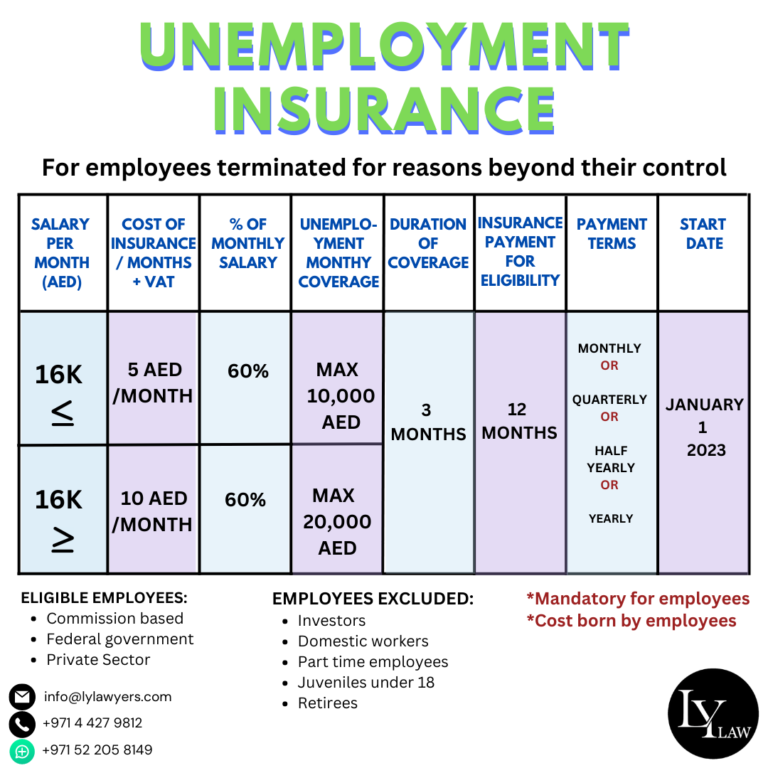
o   Maximum insurance compensation is for 3 months of unemployment.

o   Up to 60% of monthly salary. 

o   Eligibility after 1 year of paying into the scheme. 

Unemployment Insurance in the U.A.E. | Insurance Subscription Fees
(Article 3, Ministerial Decision)

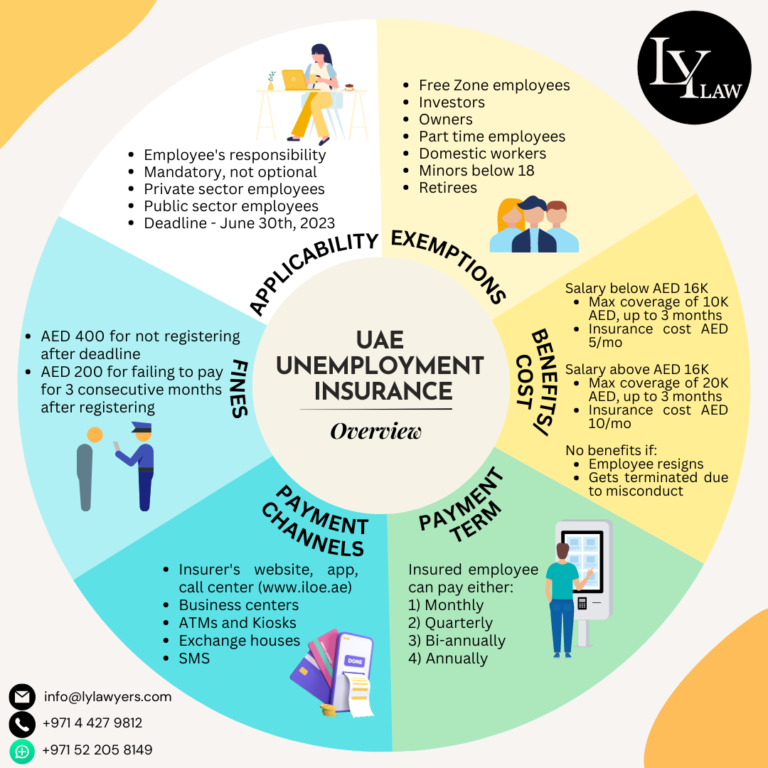
o   Those who earn less than AED 16,000.00 – AED 5/month.

o   Those whose basic salary is above AED 16,000 – at AED 10.00/month. 

o   Commission basis employees – can choose category of insurance they wish to opt-in for. 

o   Average of monthly salary over last 6 months to be used as a base.

Subscription fee can be paid: 1) monthly; 2) quarterly; 3) bi-annually; or 4) annually. (Article 5, Ministerial Resolution)

UAE Unemployment Insurance UAE

Unemployment Insurance in the U.A.E. | Applicability and Exceptions

o   Unemployment insurance is available for employees of:

§  public sector

§  private sector  

o   Exclusions:

1)    part time employees

2)    owners of businesses

3)    investors

4)    domestic workers

5)    minors below 18

6)    retirees

o   Other Exclusions

§  Free zone employees (for the time being)

§  Employees terminated for gross misconduct

§  Employees who resign

Unemployment Insurance in the U.A.E. | Insurance Provider

(Article 2, Ministerial Decision)

o   For now, in Dubai, Dubai Insurance Company is main provider of the Unemployment Insurance, https://www.dubins.ae/en/.

o   Ministry (MOHRE) can license other insurance companies.

Unemployment Insurance in the U.A.E. | Payment of the Subscription Fee (Article 4, Ministerial Decision)

1)    insurance provider’s website;

2)    insurer’s mobile application;

3)    insurer’s call center;

4)    business centers approved by the Ministry;

5)    ATMs and Kiosks, set by the insurer, and in coordination with MOHRE;

6)    exchange houses; and

7)    SMS.

UAE Unemployment Insurance UAE

Unemployment Insurance in the U.A.E. | Obligation to Pay
(Article 6, Ministerial Decision)  

o   Failure to pay for more than 3 months – terminates insurance policy.

o   Financial penalty imposed for non-compliance. 

o   In the event of a Court case, subscription must continue until work permit is cancelled, or employment ends.

Unemployment Insurance in the U.A.E. | Submission of a Claim
(Article 7, Ministerial Decision)

o   Claim for coverage to be submitted within 30 days from termination of employment. 

o   Reason mentioned in work permit cancellation (termination or resignation) will be used by insurer. 

o   Insurance provider must pay compensation within 2 weeks of application.

o   In the event of court case, final court judgment must be submitted in request for compensation, within 30 days of judgment.

o   Upon receipt of maximum compensation, employee must re-subscribe for another 12 months before becoming eligible again.

Unemployment Insurance in the U.A.E. | Penalties for Non-Compliance

(Article 9, Ministerial Decision)

o   Failure to subscribe by June 30, 2023 – subject to AED 400.00 fine.

o   Failure to pay within 3 months – subject to AED 200.00 penalty. 

o   Failure to pay penalty within 3 months:

§  Deduction of fine by MOHRE from salary through WPS, or from end of service.

§  Suspension by MOHRE of issuance of new work permits (Article 10, Ministerial Resolution). 

Unemployment Insurance in the U.A.E. | Grace Period to Subscribe

(Article 11)

However, for employees who have been employed after January 1, 2023, must register within four months from: 1) when they entered the U.A.E. with the employment entry permit; OR 2) from the change of status; OR 3) the final approval of the work permit issuance for employees who do not need a change of status.


Unemployment Insurance UAE | FAQs

At the moment the Dubai Insurance Company is appointed as the provider of the UAE Unemployment Insurance. It is compulsory for both working residents and nationals. 

No. The Unemployment Insurance UAE is mandatory for the employees and not the employers. 

The following are the list of categories who are exempted from applying for the Unemployment Insurance in the UAE.

Part-time employees, owners of businesses, investors, domestic workers, minors below 18 and retirees. 

Other exclusions include: 

  • Free zone employees (for the time being)
  • Employees terminated for gross misconduct
  • Employees who resign
  •  

Presently in Dubai, the Dubai Insurance Company is the main provider of the Unemployment Insurance. 

Yes.

  • If you fail to subscribe by June 30, 2023 – you will be subjected to AED 400 fine.
  • If you fail to pay within 3 months, you will be subjected to AED 200 fine. 
  • If you fail to pay penalty within 3 months:
    -MOHRE will deduct the fine through your salary via WPS or from end of service. 
    -MOHRE will suspend the issuance of new work permits.

Yes. You will not be able to claim for the Unemployment Insurance Scheme if you resign or get terminated from the company due to misconduct. 

June 30th, 2023 is the deadline set for the UAE employees to register for the Unemployment Insurance Scheme.

All About the UAE Unemployment Insurance Scheme

UAE Unemployment Insurance Scheme

All About the UAE Unemployment Insurance Scheme

UAE Unemployment Insurance Scheme

The UAE Unemployment Insurance Scheme is a new decision issued by the UAE Ministry of Human Resources and has come into effect in January 2023. Presently the Dubai Insurance Company is appointed as the provider of the Unemployment Insurance Scheme. It is mandatory for employees, both residents and nationals.

UAE Unemployment Insurance – Subscription 

The UAE Unemployment Insurance Scheme has two categories. The employee can subscribe and pay the fee based on the monthly salary.

Unemployment Insurance Category 1 – Subscription payment of AED 5.00 if the basic salary is less than AED 16,000.00. 

Unemployment Insurance Category 2 – Subscription payment of AED 10.00 if the basic salary is more than AED 16,000.00. 

UAE Unemployment Insurance Scheme – How to Apply

Employees may subscribe for the Unemployment Insurance Scheme though the ILOE Insurance Pool website, through its app or any other channel that the MoHRE will announce in the upcoming months.

Note – The Unemployment Insurance UAE is a mandatory requirement for the employee and the employers.

UAE Unemployment Insurance Scheme – Fee Payment

Once the employee has registered, the subscription fee can be paid through the following methods:

  1. The insurer’s mobile application;
  2. The insurer’s call center;
  3. Ministry approved business centers;
  4. ATMs and Kiosks as set by the insurer, and in coordination with MOHRE;
  5. Exchange houses;
  6. SMS.

UAE Unemployment Insurance Scheme – Payment

The insured employee can choose to pay either monthly; quarterly; bi-annually; or annually. If the employee does not pay based on the selected plan for more than three months from the due date, the insurance policy will be considered as terminated. Moreover, a financial penalty shall be imposed.

UAE Unemployment Insurance Scheme – How to Claim Benefits

  • To receive the Unemployment Insurance benefits, an employee must submit his claim for coverage within 30 days from the termination of the employment relationship. 
  • The compensation due to the employee shall be 60% of the basic salary. It is calculated based on the average for the previous 6 months. And, the compensation amount shall not exceed 3 months’ salary.
  • The insurance provider must pay the compensation amount within no more than 2 weeks of the applicant submitting all the necessary documents.

UAE Unemployment Insurance Scheme – Fines & Suspensions

  1. Non-Subscription. An employee who does not subscribe to the UAE Unemployment Insurance is liable to pay AED 400.00 after the registration period ends (June 30, 2023).
  2. Non-Payment of Subscription. If an employee subscribes to the UAE Unemployment Insurance, and does not pay within 3 months of the due date, a penalty of AED 200.00 will be imposed.
  3. Non-Payment of Penalty. If the fine is not paid within 3 months of when it is due, the charged amount will be deducted from the employee’s salary through the Wage Protection System, or from their end of service, or any other process that the MOHRE decides.
  4. Work Permit SuspensionMOHRE will suspend issuance of any new work permits for an employee who has not paid the penalties imposed for non-subscription or non-payment of the UAE Unemployment Insurance Scheme.

UAE Unemployment Insurance – Exempted Employees

The following are the list of employee categories who are currently exempted from applying for the Unemployment Insurance Scheme in the UAE.

  1. Free Zone employees.
  2. Investors (such as owners of firms in which they work),
  3. Domestic workers
  4. Part-time workers,
  5. Workers below 18 years old,
  6. Retirees who receive a pension and have joined a new job.

UAE Unemployment Insurance – Grace Period for Employees

The deadline employees have to register for the Unemployment Insurance is until June 30, 2023 following which, penalties will be imposed. For employees who have been employed after January 1, 2023, must register within 4 months from:

  1. When they entered the UAE with the employment entry permit; OR
  2. From the change of status; OR
  3. The final approval of the work permit issuance for employees who do not need a change of status.

UAE Unemployment Insurance - FAQs

Presently the Dubai Insurance Company is appointed as the provider of the Unemployment Insurance. It is mandatory for employees, both residents and nationals.

No. It is only the employees’ mandatory responsibility to register for the Unemployment Insurance.

To attain the Unemployment Insurance benefits, an employee must submit his claim for coverage within 30 days from the employment termination. The compensation shall be 60% of the basic salary.

No. Given below are the list of employee categories who are currently exempted from applying for the Unemployment Insurance Scheme in the UAE.

  1. Free Zone employees.
  2. Investors (such as owners of firms in which they work),
  3. Domestic workers
  4. Part-time workers,
  5. Workers below 18 years old,
  6. Retirees who receive a pension and have joined a new job.

Yes. An employee who does not subscribe to the UAE Unemployment Insurance is liable to pay AED 400.00 after the deadline. And, if an employee subscribes to the UAE Unemployment Insurance, and does not pay within 3 months of the due date, they will face a penalty of AED 200.00.

The Unemployment Insurance cost has two payment categories. The employee can subscribe and pay the fee based on the monthly salary.

  • Category 1 – Subscription payment of AED 5.00if the basic salary is less than AED 16,000.00. 
  • Category 2 – Subscription payment of AED 10.00if the basic salary is more than AED 16,000.00. 

Once the employee has registered online, the Unemployment Insurance fee can be paid through the following methods:

  1. The insurer’s mobile application;
  2. The insurer’s call center;
  3. Ministry approved business centers;
  4. ATMs and Kiosks as set by the insurer, and in coordination with MOHRE;
  5. Exchange houses;
  6. SMS.

Yes. You will not be able to claim for the Unemployment Insurance Scheme if you resign or get terminated from the company due to misconduct. 

June 30th, 2023 is the deadline set for the UAE employees to register for the Unemployment Insurance Scheme.

Emiratization Not Applicable to Free Zone Companies

Emiratization - Not Applicable to Free Zones

Emiratization Not Applicable to Free Zones

    1. An important clarification about the Emiratization initiative for the private sector in the U.A.E. At present, the Emiratization requirement applies to the mainland companies only.
    2. This means that free zone companies are excluded.
    3. This is because, the Emiratization initiative is being mandated by and is subject to the U.A.E. Ministry of Human Resources and Emiratization which is otherwise referred to as MOHRE.
    4. MOHRE, on the other hand, is the governing authority for the mainland companies.
    5. Free zone companies – are subject to their own free zone authorities, which serve an equivalent function to that of MOHRE.
    6. Currently, the legislative authority, which establishes the requirement of Emiratization is Ministerial Resolution No. 279 of 2022.
    7. It is this Resolution, which sets out the Emiratization quota, timeline for its implementation and corresponding penalties.
    8. This Resolution 279, applies, expressly, to establishments or companies, which are registered with MOHRE. This includes only mainland companies, and not free zones.
    9. Should free zone companies wish to adopt similar Emiratization initiative, they can do so by introducing similar regulations, as those mandated by MOHRE.
    10. Until such time, the current Emiratization requirements applies only to the mainland companies.

ALL ABOUT EMIRATIZATION

Emiratization

                • The Emiratization is being introduced into the U.A.E. private sector as of January 2023.
                • Emiratization is a government initiative to encourage meaningful and efficient employment of Emiratis in the UAE.
                • This is in line with the Ministerial Resolution No. 279 of 2022, which was issued in June of 2022.
                • As per this Resolution, the government aims to increase employment of Emiratis in the private sector by 2% annually.
                • With the objective of reaching 10% increase by 2026.
                • The requirement for the number of Emiratis to be hired, depends on the number of skilled workers in the company
                • -Companies with 51 – 100 skilled workers – should hire 2 Emiratis.
                • -Those with 101 – 150 skilled workers – must hire at least 3 Emiratis.
                • -And those companies who have more than 151 skilled workers – should hire 1 Emirati for every 50 skilled workers.
              • The deadline for compliance is January 1, 2023.
              • After which penalties will be imposed.
              • The penalties start with AED 6,000 per month for every Emirati, who has not been employed.
              • And increase by additional AED 1,000/per month, every year.

Unemployment Insurance in the UAE

Unemployment Insurance

  1. Unemployment insurance has now been officially introduced in the UAE.
  2. This was done by virtue of a brand-new law, issued by the U.A.E. President, Sheikh Mohamed Bin Zayed.
  3. The objective of the law is to:
    • Ensure income during unemployment;
    • provide social security; and
    • continue to attract and retain world’s best talent to the country.
  4. At a high level, unemployment insurance will be available for both: 1) public and 2) private sector employees.
  5. With a few exclusions, such as: 1) part time employees, 2) owners of businesses and 3) domestic workers.
  6. The maximum insurance compensation is for a period of 3 months.
  7. The law is Federal Decree Law No. 13 of 2022 regarding Insurance for Unemployment.
  8. And it came into effect on September 29, 2022.
  9. Further details will be issued in additional regulations and decisions.

New Domestic Workers Law UAE

New Domestic Workers Law in UAE

            1. Domestic workers’ rights in the UAE have been strengthen even further.
            2. By virtue of a new Domestic Workers Law.
            3. At a high level, the law, expressly,
              • Requires employers to treat workers with respect
              • Prohibits: 1) discrimination, 2) harassment and 3) forced labor,
              • Obligates employers to provide decent living conditions
              • And educate workers about their rights and how to enforce them.
            4. Furthermore, the law requires employers to:
              • Pay salary monthly, within 10 days.
              • And, document a receipt of payment, each time.
            5. Importantly, the law prohibits salary deductions.
            6. And expressly bans agencies or employers to charge workers recruitment or visa costs.
            7. The law also ensures workers the right to:
              • Keep their passports and.
              • A copy of their employment contract
            8. Most importantly, the law clearly gives workers the right to terminate their contract when employers breach any of their obligations.
            9. The new law is Law No. 9 of 2022 Regarding Domestic Workers.
            10. Replacing previous Law No. 10 of 2017.
            11. And comes into effect as of December 15, 2022.
            12. Related Podcast: https://lylawyers.com/podcast/domestic-workers-law/