
.svg)


Civil Marriage in Abu Dhabi: Process, Cost, and Eligibility (2026 Guide)
Civil marriage in Abu Dhabi is a secular, court-solemnized marriage available to non-Muslims and to non-Emirati Muslims who choose it, conducted without a religious ceremony. It is governed by Abu Dhabi Law No. 14 of 2021 Concerning Civil Marriage and Its Effects, which has been in force since January 2022, and is administered by the Abu Dhabi Judicial Department (ADJD) through its Civil Family Court.
LYLAW's family law team regularly advises residents, expatriates, and visiting couples on this process. This guide covers who qualifies, the documents and steps involved, the cost of the standard and express services, what happens on the wedding day, and how civil marriage differs from a traditional Muslim marriage in the UAE.
What is civil marriage in Abu Dhabi?
Civil marriage in Abu Dhabi is a marriage contract solemnized by a court-appointed notary public rather than a religious officiant. Abu Dhabi's civil marriage framework was introduced under Abu Dhabi Law No. 14 of 2021 concerning Personal Status for Non-Muslim Foreigners, which established a civil legal framework for matters including marriage, divorce, child custody and inheritance. It was introduced to give non-Muslim residents, expatriates, and tourists, and non-Emirati Muslims who prefer it, a legal route to marry in the UAE without following Sharia-based procedures. The Abu Dhabi Civil Family Court, part of the ADJD, has exclusive jurisdiction over these marriages under Articles 4 and 5 of Law No. 14 of 2021.
Who can apply for a civil marriage in Abu Dhabi?
Eligibility for civil marriage in Abu Dhabi depends on age, marital status, and one nationality-based restriction: UAE nationals who are Muslim cannot use this route. Foreign nationals qualify regardless of religion, including Muslim foreigners and tourists, and so do non-Muslim UAE nationals.
- Age: Both parties must be 18 years or older, per the ADJD's own eligibility criteria for this service.
- Consent: Both parties must give free consent before the court; no guardian or family approval is required.
- Marital status: Both parties must be single, divorced, or widowed, with documentary proof if previously married.
- Kinship: The parties cannot be related within the first or second degree.
- Nationality and religion: The only exclusion is UAE nationals who are Muslim. Non-Emirati Muslims, non-Muslims of any nationality, and interfaith couples are all eligible.
A premarital medical screening certificate is not required for civil marriage, which is one respect in which the process is simpler than some other marriage routes in the UAE.
Civil marriage in Abu Dhabi for foreigners and tourists
Foreigners do not need UAE residency to have a civil marriage in Abu Dhabi; tourists and visitors on a valid entry visa qualify on the same terms as residents. A resident applies with an Emirates ID and UAE residence visa copy, while a visitor applies with a passport and valid entry visa or e-visa stamp, since physical presence in the UAE is required for the ceremony itself.
Can non-Emirati Muslims choose civil marriage in Abu Dhabi?
Yes, non-Emirati Muslims can choose civil marriage in Abu Dhabi under the same law, provided both parties consent to it. The eligibility rules, fees, and application steps are identical to those for non-Muslim couples; LYLAW's separate guide for Muslim couples covers the additional considerations specific to that route.
Documents required for an Abu Dhabi civil marriage application
The documents required depend on whether an applicant is a UAE resident or a visitor, and on whether either party was previously married.
How to apply for a civil marriage in Abu Dhabi
The application for an Abu Dhabi civil marriage is filed with the ADJD before the ceremony date is confirmed.
- Submit the civil marriage application and supporting documents through the Abu Dhabi Judicial Department's designated online service.
- Complete the application form and upload the required documents for both parties.
- Select a service tier, standard or express, which determines the fee and how quickly a ceremony date is confirmed.
- Pay the applicable court fee through the ADJD's online payment link.
- Receive confirmation by SMS or email once the application is approved, including the assigned or selected ceremony date and time.
- Attend the ceremony at the ADJD Civil Family Court with the confirmation notice, passports, and Emirates IDs where applicable.
Standard and express civil marriage services: cost and timeline
The ADJD runs two service tiers for civil marriage in Abu Dhabi, priced differently depending on how quickly the couple needs a ceremony date.
Other costs to budget for
The ADJD fee for authenticating a civil prenuptial agreement is AED 950. Couples relying on foreign-issued documents, such as a divorce certificate or death certificate from another country, should also budget for attestation through the UAE Ministry of Foreign Affairs and International Cooperation and, where the document is not in Arabic or English, certified translation; both add variable cost and time outside the ADJD's own fees.
What happens at an Abu Dhabi court marriage ceremony?
An Abu Dhabi court marriage ceremony takes place at the ADJD Civil Family Court and typically lasts around 15 minutes. The ceremony is conducted before the competent ADJD official. Couples are not required to bring their own witnesses. Couples may exchange rings, read personal vows, and invite guests, photographers, and videographers. A bilingual marriage certificate is issued shortly after the ceremony.
Civil marriage versus Muslim marriage in Abu Dhabi
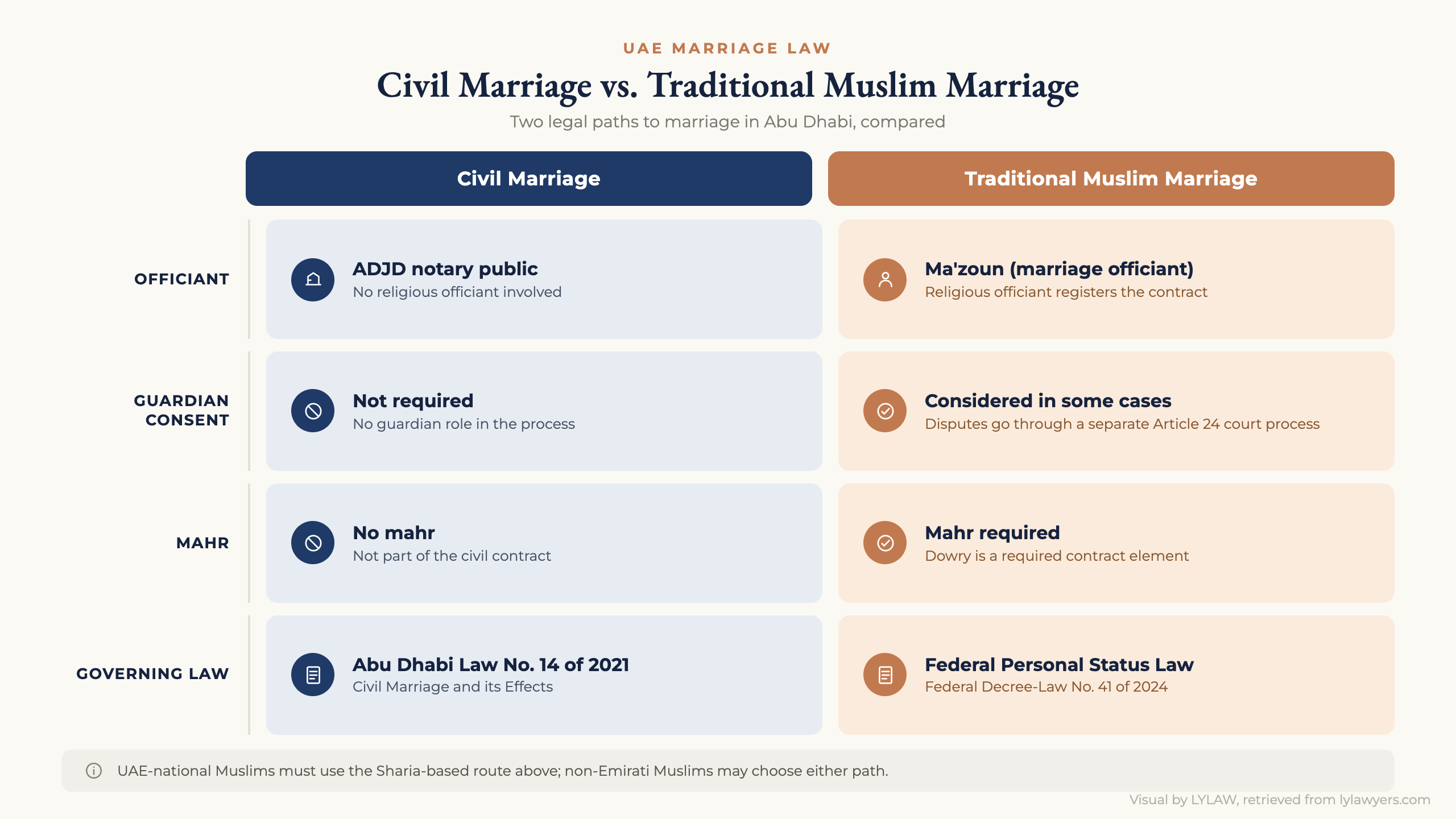
Civil marriage and traditional Muslim marriage in Abu Dhabi are governed by different legal frameworks and follow different procedures. Civil marriage is a secular contract solemnized by an ADJD notary public under Law No. 14 of 2021, with no mahr (the dower paid by the groom), no marriage officiant (ma'zoun), and no guardian consent requirement. A traditional Muslim marriage in the UAE, by contrast, is governed by the federal Personal Status Law, is solemnized by a ma'zoun, and includes the mahr and, in some cases, guardian consent considerations. UAE-national Muslims cannot opt out of the Sharia-based route into civil marriage, regardless of consent; non-Emirati Muslims may choose either route.
Guardian consent disputes for a traditional marriage are handled separately from civil marriage under Article 24 of the amended Personal Status Law, which is a distinct court process from the one described in this guide.
Recognizing an Abu Dhabi civil marriage outside the UAE
A marriage certificate issued by the ADJD Civil Family Court is generally recognized outside the UAE once it has been attested. Couples who intend to use an Abu Dhabi civil marriage certificate outside the UAE should have the certificate attested by the UAE Ministry of Foreign Affairs.
Limitations of Abu Dhabi's civil marriage system
The main limitations of an Abu Dhabi civil marriage are its exclusion of UAE nationals who are Muslim and the attestation work that foreign-issued documents require. Couples relying on foreign-issued civil status documents should expect the attestation chain for those documents, rather than the ADJD process itself, to be the main source of delay, and should confirm current attestation requirements with MOFAIC before relying on a fixed timeline.
LYLAW advises on civil marriage, pre-nuptial agreements, and related personal status matters across the UAE. For guidance specific to your circumstances, contact LYLAW's family law team to arrange a consultation.
This article provides general information only and does not constitute legal advice. The law and its application depend on individual circumstances and may change over time. For advice specific to your situation, please contact the LYLAW team.