.svg)


Health Checks and UAE Residency: What Every Expat Must Know
Failing the UAE's mandatory visa medical test can mean more than a rejected application. For a small number of conditions, most applicants will never test positive for, it can mean deportation under Federal Decree-Law No. 29 of 2021, even for someone who already holds a valid residence visa.
This guide covers:
- Which health conditions carry the highest risk of visa refusal or deportation
- The full list of required medical tests, and how requirements differ by visa type
- Who is exempt, either from the test itself or from TB-based disqualification
- Where to take the tests and what they cost
- What changed under the 2022 and 2025 amendments to the medical examination system
Which health conditions can get a UAE visa refused, or a resident deported?
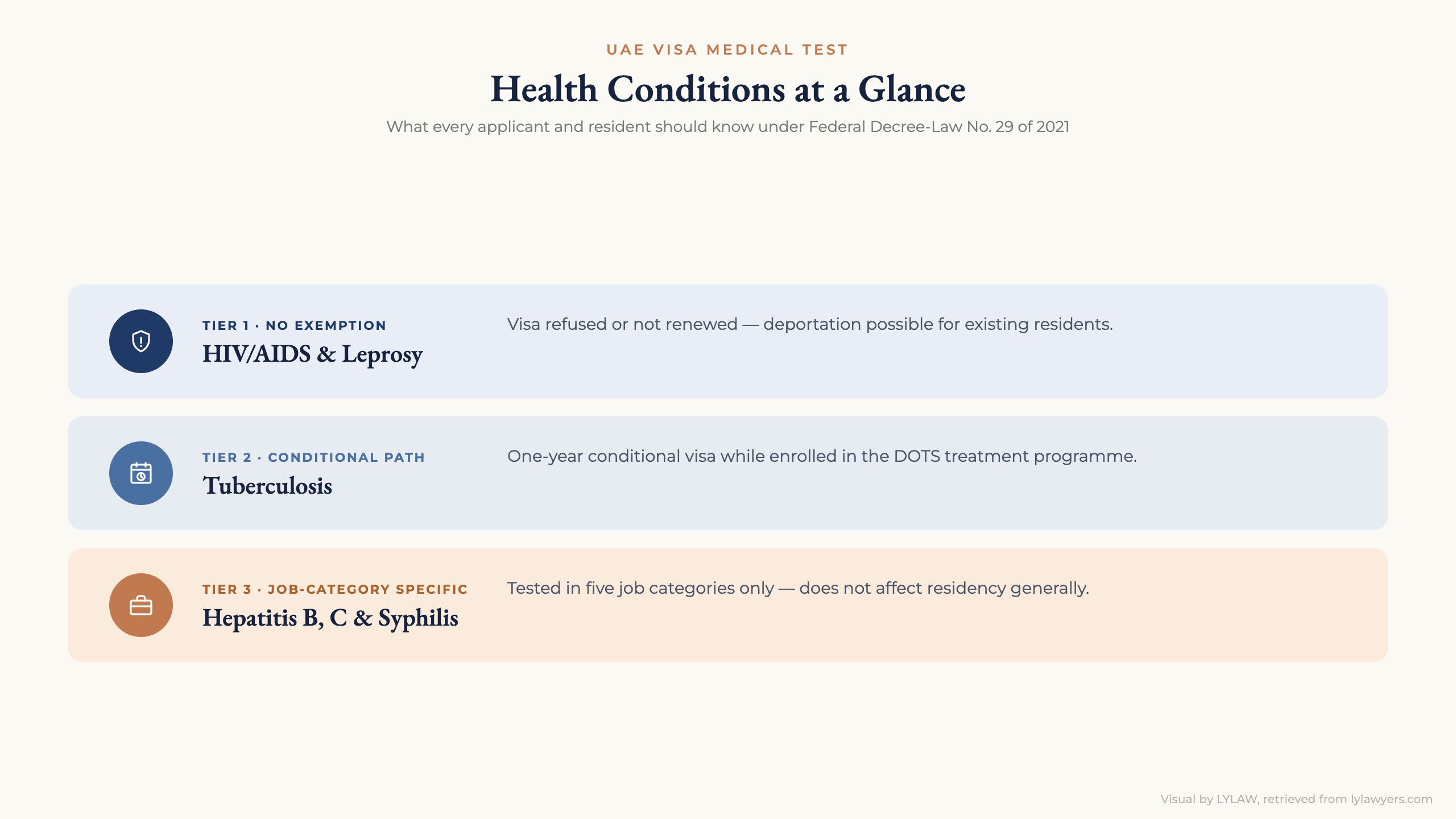
The health conditions that can get a UAE visa refused, or a resident deported, are HIV/AIDS, leprosy, tuberculosis, and, in five specific job categories, hepatitis B, hepatitis C, and syphilis. HIV/AIDS and leprosy result in refusal or deportation with no exemption. Tuberculosis allows a conditional one-year visa under supervised treatment before deportation becomes possible. Hepatitis B, hepatitis C, and syphilis are tested only in five specific job categories, and a positive result affects that job category, not residency in general.
Is HIV grounds for deportation in the UAE?
Yes, HIV is grounds for deportation in the UAE. A positive result reaches an existing resident at visa renewal, as well as a new applicant. Cabinet Resolution No. 7 of 2008 states that residency "shall not be prevented or renewed for positive cases, and it shall be considered unfit for health." Being "unfit for health" matters because "public health" is itself a deportation ground under UAE law. Article 15 of Federal Decree-Law No. 29 of 2021 on the Entry and Residence of Foreigners allows the Federal Public Prosecutor or an authorised representative to order deportation "if such deportation is required by the public interest, public security, public morals, or public health," even where the person "has a visa or residence permit." LYLAW's immigration lawyers can advise on how this applies to a specific case.
The Cabinet Resolution does contain a general clause letting the Minister or a health authority head exempt "some cases" from the health-fitness condition. Treat that as the practical rule rather than as a legal impossibility that a lawyer could never challenge.
Can I work in Dubai if I have hepatitis B?
Yes, you can work in Dubai with hepatitis B in almost any role, because hepatitis B and C testing applies to only five occupational categories: domestic workers, babysitters, kindergarten and nursery staff, salon and health club employees, and healthcare workers. Outside those categories, hepatitis B is not tested at all and has no bearing on a visa application.
Inside those categories, a positive result does not end the application outright: the law gives 30 days to switch to a different job category before the visa is refused or not renewed. A negative result carries its own requirement, a full three-dose hepatitis B vaccination course, with the vaccination certificate required again at the next renewal.
Is syphilis banned in the UAE?
No, syphilis is not banned in the UAE. Testing applies only to the same five job categories tested for hepatitis B and C. A positive result requires completing treatment before the applicant is certified medically fit; it does not carry the automatic refusal or deportation risk that HIV, leprosy, and non-compliant tuberculosis carry.
Tuberculosis: the one condition with a path back to a valid visa
A new applicant with active or old pulmonary tuberculosis is refused outright. A resident renewing a visa is treated differently: the certificate is marked "subject to treatment" and a one-year conditional visa is issued, provided the person enrols in the government's Directly Observed Treatment, Short-course (DOTS) programme. Missing three consecutive follow-up appointments during that year results in the person being reclassified as unfit for health, which reopens the deportation risk described above. Drug-resistant cases must complete treatment before any renewal is considered.
Some categories are exempt from TB-based disqualification specifically, though not from testing or monitoring:
- Diplomatic and consular corps members, on the Ministry of Foreign Affairs' recommendation
- Immediate family of a resident (spouse, children, parents)
- Major investors, subject to the local authority's approval
- Other individuals a joint committee under the Ministry of Health designates
Every exempt case still goes through DOTS follow-up.
The full list of UAE visa medical tests, by category
The table above sets out who is tested for HIV, tuberculosis, hepatitis B and C, and syphilis, and what a positive result means. The list below is the full set of tests administered, with two scheduling and eligibility notes specific to the tests themselves.
Who is exempt from the UAE visa medical test?
Exemption from the UAE visa medical test comes in two different forms, which are easy to confuse.
The first is whether you take the test at all, which is a visa-type question. These categories do not need to take the test at all:
- Tourists and visit-visa holders
- Dependents under 18
- Non-citizen family members of UAE nationals
- The diplomatic corps
Everyone else applying for an employment, family, dependent, investor, Golden Visa, Green Visa, or student visa aged 18 or over does need to take the test.
The second is whether a positive TB result disqualifies you, which is a separate, narrower question covered in the tuberculosis section above. Diplomats, immediate family of residents, major investors, and other Ministry of Health-designated individuals are exempt from TB-based disqualification specifically, not from the test itself or from monitoring.
Where to take the test, and what it costs
Tests must be conducted at a government-authorized preventive medicine centre. Cabinet Resolution No. 7 of 2008 restricts testing to "the preventive medicine centres of the Ministry of Health of the State, the government health authorities and such other authorities as may be designated by Resolution of the Minister of Health."
In practice, this means:
- Dubai Health's network of centres, including its premium Smart Salem service for faster results
- SEHA's Disease Prevention and Screening Centres and the Capital Health Screening Centre in Abu Dhabi
- Emirates Health Services public health centres across Sharjah, Ajman, Ras Al Khaimah, Fujairah, and Umm Al Quwain
Standard processing costs approximately AED 250 to 320 (24 to 48 hours). Same-day premium services cost AED 700 or more.
What changed under the 2022 and 2025 amendments
Cabinet Resolution No. 7 of 2008 has been amended more than once. Cabinet Resolution No. 75 of 2022:
- Made HIV/AIDS testing mandatory at both first issuance and renewal, not only at entry
- Extended the tuberculosis-at-renewal requirement to all residents
- Extended hepatitis B and C screening to additional categories beyond the original list
A more recent change, Cabinet Resolution No. 4 of 2025, repealed Article 10 of the original 2008 resolution.
Certificate validity and centralized reporting
A certificate of freedom from a public health disease is valid for three months from its issue date. If it is not submitted for visa processing within that window, the tests must be retaken. All results feed into a centralized government system, which keeps statistical records of disqualified applicants by nationality, gender, age, and condition.
What this means before you apply
Most applicants pass without incident: the conditions covered here are uncommon, and four of the six only apply to five specific job categories in the first place. For the small number of people who do test positive, the consequences range widely, from a straightforward 30-day job-category change for hepatitis B or C, to a genuine deportation risk for HIV, leprosy, or non-compliant tuberculosis. Knowing which category a result falls into, and which visa type and job category apply, is what determines the outcome.
LYLAW's immigration team advises residents and employers on visa medical test outcomes, TB and DOTS compliance, and deportation risk under Federal Decree-Law No. 29 of 2021. Contact LYLAW's immigration lawyers to discuss a specific result or application.
This article provides general information only and does not constitute legal advice. The law and its application depend on individual circumstances and may change over time. For advice specific to your situation, please contact the LYLAW team.