



Surrogacy in Abu Dhabi: Costs, Contracts, and Steps for UAE Residents
Couples can use gestational surrogacy in Abu Dhabi when the wife has a qualifying medical reason, under version 2 of the Department of Health (DoH) Gestational Surrogacy Standard, in force since April 2026. The standard sets no residence rule, so couples living in other emirates may apply, but confirm in writing that the DoH will accept your file. In the UAE, gestational surrogacy means a surrogate carries an embryo made from the couple's own egg and sperm, so she has no genetic link to the baby. The Abu Dhabi route therefore needs four things: a married couple, their own egg and sperm, a certified medical reason, and approval from a DoH committee before treatment starts.
For a couple told that the wife cannot safely carry a pregnancy, this is a lawful route at home. Abu Dhabi currently has the only published surrogacy pathway in the UAE, so Dubai residents who qualify look to Abu Dhabi. The legal background, including the 2023 federal amendment and Article 9, is covered in our podcast episode on surrogacy in the UAE. Below are the eligibility rules, the approval steps, the costs and contract terms, and the checks to run before you pay.
Key takeaways
- Gestational surrogacy is available in Abu Dhabi under version 2 of the DoH standard, effective April 2026, and couples in other emirates may apply if the DoH accepts their file.
- A married couple may qualify when the wife is 18 to 47 and has a certified medical reason, neither spouse has a transmissible disease, the embryo uses their own egg and sperm, and the DoH committee approves.
- Abu Dhabi has the only published surrogacy pathway, so Dubai residents who qualify look to the Abu Dhabi route.
- The DoH Medical Committee approves each case and tells the facility to start treatment within 5 working days.
- In the agreement LYLAW reviewed, the package cost around USD 260,000 for up to four transfers, with no refund.
- The spouses become legal parents at birth through an administrative step in the DoH standard, with no federal statute behind it.
Who qualifies for surrogacy in Abu Dhabi?
A married couple qualifies for surrogacy in Abu Dhabi when the wife is aged 18 to 47, a doctor certifies one of the medical reasons in the DoH standard, and the embryo comes from the couple's own egg and sperm. Convenience is not a reason: the DoH Medical Committee for Gestational Surrogacy, which decides whether the medical reason is met, applies the criteria of the DoH Gestational Surrogacy Standard.
- She is 18 to 47 and, in the doctors' assessment, able to raise a child.
- She has a disorder of the uterus that makes implantation impossible, such as congenital absence of the uterus or Asherman's syndrome.
- She has had repeated implantation failure or recurrent pregnancy loss, and the committee accepts this as the reason.
- A serious medical condition means pregnancy would put her or the baby at risk of death.
- Neither spouse has a disease that can pass to the child.
Donor eggs, sperm and embryos are not allowed, so a couple who need a donor have to look at surrogacy abroad.
The standard sets no nationality or residence rule for the spouses, so couples in other emirates and foreign nationals may apply, but confirm in writing that the DoH will accept your file. It is written for "spouses". Under Article 8(2) of Federal Decree-Law No. 17 of 2023, non-Muslim couples without a marriage certificate may apply for fertility treatment if they file an acknowledgement of the child's lineage, certified by the authority of the child's future nationality, but the standard does not mention them.
A married expat couple in Dubai, wife born without a uterus. The standard was written for this case. Two checks come first: that the DoH accepts the file of a couple living in Dubai, and that their home country will recognise an Abu Dhabi birth certificate.
An unmarried non-Muslim couple. Get the DoH position in writing before you spend a dirham, and have the Article 8(2) lineage acknowledgement ready.
Requirements for the surrogate mother in the UAE
Version 2 of the DoH standard, effective April 2026, sets these requirements for the surrogate.
- She is 21 to 45 years old, with a body mass index (BMI) between 19 and 30.
- She has been pregnant at least once and has given birth no more than 4 times.
- She has had no more than two Caesarean sections, with no isthmocele (a defect in the Caesarean scar).
- She has no history of illicit drug use or alcoholism.
- She passes a full medical and psychological evaluation.
- If she is married, her husband signs a consent form.
Some websites still quote version 1 of January 2025, so check that a provider works to version 2.
The surrogacy process in Abu Dhabi, step by step
The Abu Dhabi process runs from a first clinic evaluation, through approval by the DoH committee, to a birth that both spouses attend. Expect well over a year from first enquiry to birth. The DoH standard sets the order of the steps.
- A DoH-authorised fertility facility evaluates the couple, medically and psychologically.
- Two consultants sign a medical report, and the facility sends the request to the DoH Medical Committee, which decides whether surrogacy is medically necessary.
- Once the committee approves eligibility, the facility selects a surrogate through an approved surrogacy agency and completes her medical and psychological examinations. The standard places surrogate selection after committee approval.
- The spouses, the surrogate and her husband, if she is married, sign a notarised agreement and separate consent forms. A notarised agreement is signed before a Notary Public, who confirms the identity of each signatory.
- The committee validates the file and asks a legal partner to check that the Notary Public signed and verified the agreement.
- The committee tells the facility to start treatment within 5 working days.
- Treatment is IVF only. PGT-A, a screening test of the embryos for an abnormal number of chromosomes, is mandatory, and only single embryo transfers are allowed, so one embryo goes into the surrogate at each attempt.
- The surrogate receives antenatal care at a DoH-approved maternity hospital, and a facility with no full pregnancy service refers her to one under a DoH-approved procedure.
- Both spouses are physically present on the day of the birth.
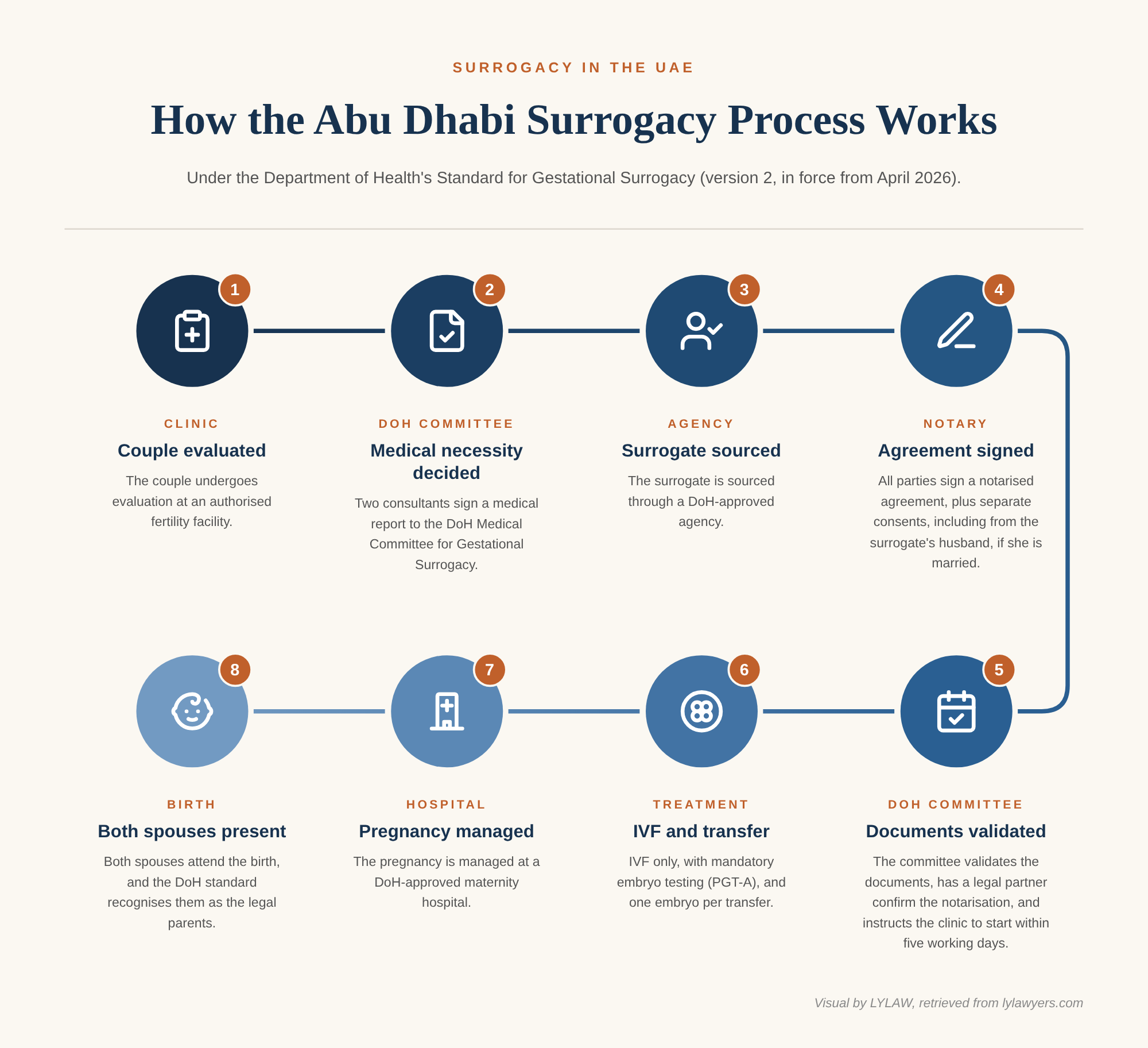
Each step leaves a record with the committee, which also reviews a monthly report from the facility and may ask for any document before it decides; a missing consent form, or an agreement that the notary has not verified, stops the file at step 5. One embryo per attempt can mean several attempts, which is why packages are priced for a set number of transfers. If the wife is near 47, start early: the whole route can take well over a year.
How much does surrogacy cost in Abu Dhabi?
In the agency agreement LYLAW reviewed, an all-inclusive surrogacy package in Abu Dhabi cost around USD 260,000 (about AED 955,000 at the fixed rate of AED 3.6725 to the dollar) for up to four embryo transfers. The headline figure tells you little until you read what each package includes. Under the reviewed agreement, every extra attempt after the fourth transfer cost AED 35,000.
The reviewed package split the costs as follows.
Insurance is a cost of its own. Under clause 4.6.5 of the DoH standard, the spouses must buy a private policy that covers all surrogacy-related health services and pay whatever it does not cover, because Thiqa, Basic, Enhanced and other government-funded cover cannot be used. Ask the agency whether its price includes that policy, and who pays for a Caesarean section or neonatal care that the policy limit leaves uncovered. The fee was also non-refundable, as the contract section below explains, so settle these points before the first payment.
Examples in this section are anonymised and illustrative only. Please read the disclaimer at the end of this article.
Is the surrogate paid in Abu Dhabi?
Yes. The DoH consent form commits the spouses to "the agreed compensation and reimbursement to the surrogate for her time, health care and participation". With no fee cap or payment schedule in the standard, the amounts come from the surrogacy agreement, and in the one LYLAW reviewed the agency paid them on the couple's behalf.
- USD 500 at embryo transfer, and USD 700 when the pregnancy was confirmed.
- USD 700 a month from confirmation for up to nine months, plus a USD 700 clothing allowance.
- USD 24,000 on delivery of one baby at 37 weeks or more, or USD 26,000 for twins at 34 weeks or more.
- USD 1,500 more for a medically required Caesarean section, and set sums for complications, such as USD 5,000 for loss of the uterus or fertility.
For one full-term baby, that comes to about USD 32,000, roughly 12% of the package price. The rest of the fee pays for medical care, logistics and the agency.
What a surrogacy contract in Abu Dhabi covers
A surrogacy package in Abu Dhabi involves two contracts, an agency agreement and a surrogacy agreement, and in the package LYLAW reviewed, the agency refunded none of its fee in any circumstance, including a failed pregnancy or a miscarriage. The terms that cost money when something goes wrong are the ones to read first.
The agency agreement. The agency acts as a coordinator only: the contract says it is not an agent, fiduciary, medical provider or legal adviser. The agreement we reviewed set these commercial terms.
- No refund in any circumstance.
- No pause in the programme beyond three months.
- Interest of 10% a month on late payments.
- No responsibility for parentage or citizenship outside the UAE.
The surrogacy agreement. This contract is between the couple and the surrogate, and the agency administers every payment. In the agreement we reviewed, it ended after four embryo transfers. The surrogate moved to Abu Dhabi and lived under lifestyle rules with fixed penalties from AED 500 to AED 10,000 depending on the breach. She needed clearance to leave her residence or the country, at AED 1,000 to AED 5,000 per breach, and faced a AED 20,000 penalty for trying to identify the parents.
If a transfer fails or the surrogate withdraws, these contracts gave the couple no money back, and the surrogacy agreement ended once 4 transfers were used. Put your own lifestyle preferences, such as diet, in a written schedule to the agreement; otherwise there is nothing to measure a breach against.
The contract promised anonymity, but the paperwork limits it. Both parents attend the birth, the DoH consent forms record every party's details, and the notary identifies each signatory.
What if a dispute arises over a surrogacy contract in the UAE?
A UAE court may adjust or refuse to enforce several clauses that surrogacy contracts commonly contain, so deal with them before you sign.
- Since June 2026, a UAE court may reduce a fixed penalty if the payer proves it is excessive (Article 340, Federal Decree-Law No. 25 of 2025), so fixed penalties do not enforce themselves.
- Limits on a foreign surrogate's movement raise personal-liberty and public-order questions, so tie each one to a documented medical reason, and never hold her passport.
- A contractual travel restriction is not a travel ban, which only a court or, in criminal matters, the Public Prosecution can impose.
- Termination of pregnancy is decided under UAE medical law and by the doctors, and the contract can only record wishes.
- A genetic-error clause cannot settle custody, because the child's welfare is decided under personal status law.
- Guardianship after a parent's death cannot be assigned by contract, so both parents need wills before the birth.
- The agreement we reviewed had no signature line for the surrogate's husband and referred to "one or more" embryos, although only one is allowed per transfer.
Is a child born through surrogacy in Abu Dhabi legally yours?
In Abu Dhabi, yes, on paper: the DoH standard recognises the spouses as the legal parents at birth. That status rests on an administrative step in the DoH standard itself, with no federal statute behind it, and personal status law ties maternity to proof of birth. The genetic link and the legal link are separate questions. At birth the surrogate renounces her rights, the wife gets her own medical record so the newborn is registered under her name, and the birth certificate follows the notarised agreement.
No federal personal status provision makes the genetic mother the legal mother where another woman gave birth. For Muslim families, lineage (nasab, the legal descent of a child from its father and mother) is set by Article 87 of Federal Decree-Law No. 41 of 2024 on Personal Status, which proves a child's lineage to the mother by proof of birth. For non-Muslim families, Article 14(1) of Federal Decree-Law No. 41 of 2022 on Civil Personal Status establishes parentage by marriage or by the acknowledgment of the father and mother, and under Article 1(1) of the same law, foreign non-Muslims may ask for their home-country law to govern proof of parentage. Article 87 matches the classical rule that the mother is the woman who gives birth, which is why a Muslim family's file needs the most care. Clause 4.11.4 of the DoH standard records the birth in the surrogate's medical file and opens a parallel record for the wife, so if a court treats the surrogate's file as the proof of birth, the wife's maternity is open to challenge. Neither law addresses surrogacy (the English translation of Article 14(3) of the 2022 law mentions "surrogate families", but the Arabic text means alternative families for children in care), so the questions come later: in divorce and custody if maternity is challenged, in inheritance, in recognition by your home country, and in nationality, which follows parentage.
Keep these four documents together in one parentage file from the day the DoH approves your case.
- The DoH approval.
- The notarised agreement and every consent form.
- The genetic test results.
- The documents your home country needs to recognise the birth certificate.
Surrogacy abroad for UAE residents
Surrogacy abroad is the only route for UAE residents who need donor eggs or sperm or who do not meet the DoH criteria, and the UAE still controls parts of it.
- Under Article 17 of Federal Law No. 7 of 2019, embryos, eggs and sperm cross the UAE border only under its Executive Regulation procedure; Article 26 sets the penalties.
- A couple with their own embryos frozen abroad can use them in Abu Dhabi if the embryos are tested to DoH standards and imported properly.
- If a donor was used abroad, expect closer scrutiny of parentage, especially for Muslim families.
Take advice in both countries before you sign anything abroad.
How other countries make intended parents the legal parents
In the UAE, parentage rests on an administrative step; elsewhere a statute or a court fixes it.
In Canada, the Assisted Human Reproduction Act prohibits paying a woman to be a surrogate mother, although her receipted expenses may be reimbursed. In Italy, since 3 December 2024, Law No. 169 of 4 November 2024 punishes surrogacy by an Italian citizen even abroad.
Bringing a baby born through surrogacy abroad to the UAE
A child born abroad gets the first documents abroad: the birth certificate from the country of birth, and the passport and nationality from the parents' home country.
UAE nationals take the foreign birth certificate to the nearest UAE embassy and apply for a UAE birth certificate within 30 days of the birth; the embassy arranges a return document for the newborn. Expatriates follow three steps.
- Have the foreign birth certificate attested (a chain of official stamps that lets a document issued abroad be used in the UAE): notarised or authenticated in the issuing country, then stamped by that country's foreign ministry, the UAE embassy there, and the Ministry of Foreign Affairs in the UAE. An apostille alone is not accepted in the UAE.
- Get a home-country passport and a UAE entry permit for the child. In Dubai, the GDRFA family entry permit requires an attested birth certificate.
- Complete the residency requirements within the 60 days from entry that the permit gives.
The 120-day residence visa deadline, with its AED 100 daily fine, applies to babies born in the UAE. Where the foreign certificate does not yet name the intended parents, as in England and Wales before a parental order, nothing yet links the child to the sponsoring parent for UAE residency.
How to check surrogacy clinics and agencies in the UAE before you pay
Ask any clinic or agency for written DoH approval before you pay, because the DoH publishes no list of approved surrogacy agencies and agencies make conflicting licence claims. An agency's website is not evidence of its approval. The DoH ART programme page says surrogacy is offered at selected facilities "including" four named hospitals, so its list may not be complete. Two agencies each describe themselves as the only or the first licensed provider, and the two claims are hard to reconcile. Confirm any such claim through the DoH or the referring facility.
Before you pay anything, ask for four things in writing.
- The DoH approval of the facility or the agency.
- The trade licence and the activity it covers.
- The name of the partner hospital or clinic, which you can then check against the DoH list.
- A statement of who holds your money, and when it is released, because the fee may be non-refundable once paid.
Take advice before you sign, in the UAE and in every other country involved, and start the parentage file on the day the DoH approves your case. If you are weighing the Abu Dhabi route or a programme abroad, LYLAW's personal status lawyers can review the agency agreement, the surrogacy agreement and your parentage documents with you before anything is signed. Book a consultation.
LYLAW holds client information and client relationships in the strictest confidence. Where this article refers to real-life scenarios, they are illustrative examples only, with names and identifying details withheld. The content is provided solely for informational and educational purposes. It should not be regarded as a definitive assessment of the matters discussed or interpreted as a prediction or guarantee of the outcome in any separate matter, which will depend on its own facts.
This article does not constitute legal advice. Applicable laws, their interpretation, and application may vary depending on the nature and circumstances of each matter, differ across emirates and jurisdictions, and evolve over time. The information is current as of the date of publication. Reading this article does not establish an attorney-client relationship with LYLAW. For legal advice specific to your circumstances, please contact the LYLAW team.