
.svg)


Real Estate Agent Laws in Dubai: What Every Agent and Brokerage Must Know
Dubai licenses real estate brokers the way it licenses lawyers and doctors: through a register, a code of ethics, and a body of law that runs four levels deep. Bylaw No. 85 of 2006 alone sets out twelve separate duties for every broker in the emirate, and more than thirty federal and Dubai instruments touch an agent's daily work, from the Constitution down to a QR code on a property ad.
This guide sets out the rules that decide who gets paid, who holds the deposit cheque, and who is liable when a deal collapses. It draws on the framework set out for real estate professionals, together with the Dubai court decisions that show how these rules play out in practice.
Key takeaways for agents and brokerages
- A commission claim needs a broker card issued through a licensed brokerage, whatever the claim is called.
- A contract is a contract, whether it is a WhatsApp message, an email, or a signed booking form.
- Agents pass on information; legal advice on a deal belongs to a licensed lawyer.
- Paper every mandate through Form A, Form B or Form I; without that paperwork there is no advertising permit and no fee.
- A deposit cheque is held in trust and released only on the written terms of Form F.
- Verify before marketing: the developer, the project, the escrow account, the permits and the authority to sign.
- Follow the money: no personal accounts, report cash from AED 55,000 and any crypto payment, and never tip off a client under review.
- Promotion is regulated twice, once by RERA's advertising permit and again by the Media Council's Advertiser Permit.
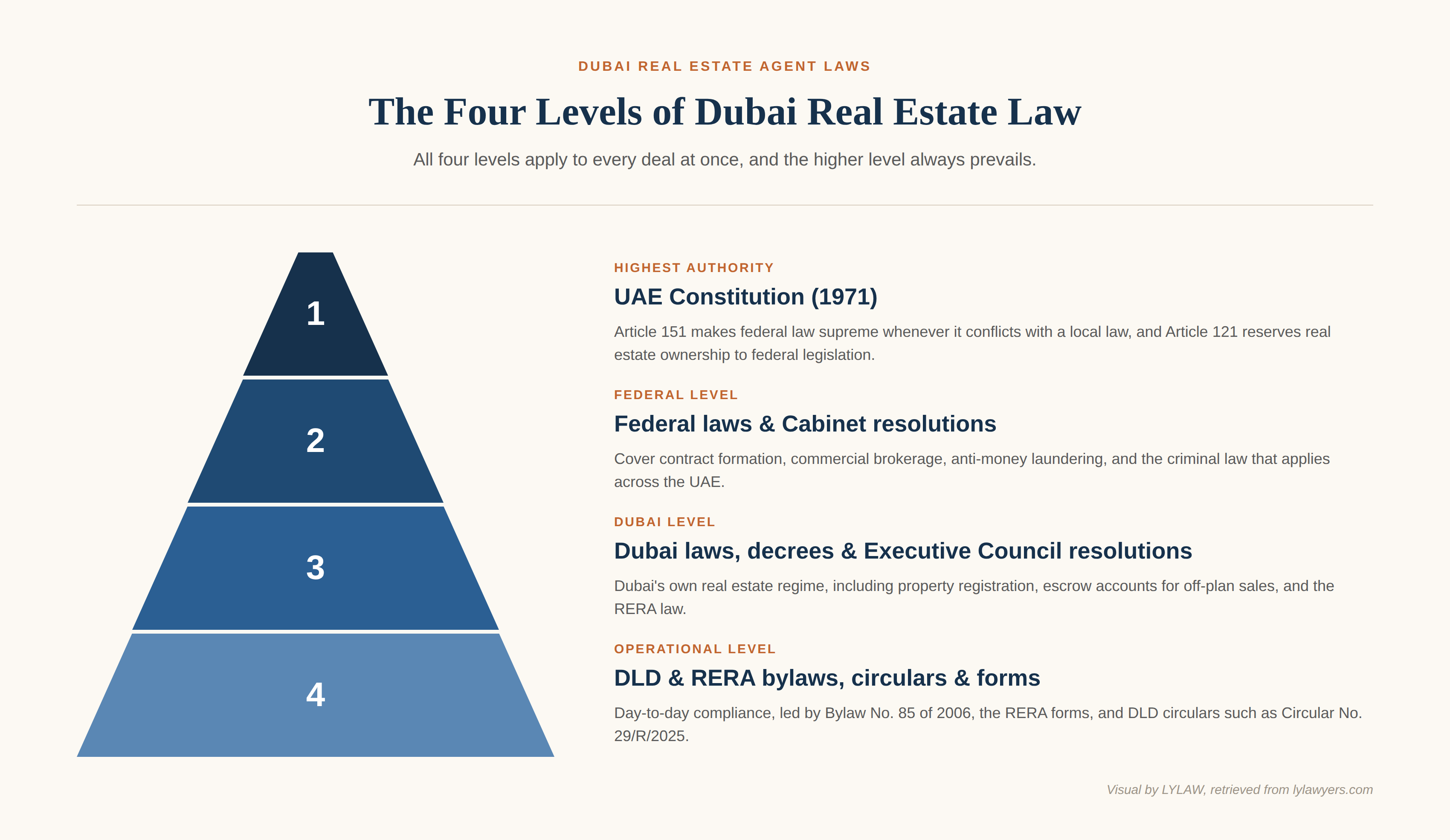
Four levels of law govern every Dubai real estate agent
There is no single "Dubai real estate agent law." Four layers of law apply to every deal at once, and an agent does not get to choose which one governs:
- The UAE Constitution of 1971 is the top layer. Article 21 protects private property, and Article 151 makes federal law supreme whenever it conflicts with a local law.
- The second layer is federal law and the Cabinet resolutions that implement it, covering everything from contract formation to anti-money laundering.
- Dubai then writes its own laws, decrees and Executive Council resolutions for its own market, including the Real Property Registration Law and the Escrow Law.
- The fourth layer comes from the Dubai Land Department (DLD) and its regulatory arm, the Real Estate Regulatory Agency (RERA), which issue their own bylaws, circulars, forms and guides, including Bylaw No. 85 of 2006, the single instrument that governs the day-to-day conduct of a broker.
Who is legally allowed to work as a real estate agent in Dubai?
A person may work as a real estate agent in Dubai only if they hold a trade license for brokerage from the Dubai Department of Economy and Tourism and are registered in Dubai Land Department's RERA division's brokers register, as Article 3 of Bylaw No. 85 of 2006 requires: "No Person may engage in Real Estate Brokerage activities in the Emirate unless he is licensed by the Competent Entities and entered in the Register."
Article 6 lists what registration requires:
- A trade license for brokerage.
- Chamber of Commerce membership.
- A physical office.
- A certificate of good conduct.
- No bankruptcy record and no crimes of dishonor for the company's managers.
- For individual agents: RERA-accredited training (in practice, the Dubai Real Estate Institute course), the RERA exam, and a broker card issued through a licensed brokerage.
There is no lawful route to freelance brokerage in Dubai. The broker card is issued through, and tied to, a licensed brokerage. Side deals arranged by unregistered individuals fall outside the law entirely.
Unlicensed or unregistered brokerage is void as a matter of public order. No commission is owed, no damages are available, and no expenses are recoverable, and Dubai courts raise the point on their own motion even when the defendant does not appear to argue it. In one 2025 case, a claimant sought AED 394,800 for introducing a buyer to three units without ever holding a broker's license; the claim failed outright (Civil Partial No. 41/2025). Relabeling the claim as "damages" or "unjust enrichment" instead of commission does not change the outcome.
Two administrative rules round out the licensing regime. Article 12 requires the broker's name and registration number on every piece of correspondence, and Article 13 requires annual renewal.
What can a Dubai real estate agent do for a client?
A Dubai real estate agent informs the client, holds client money in trust and may act for one side or both, but cannot give legal advice or become a party to the deal, so the role is narrower than most clients assume. Article 17 of Bylaw No. 85 of 2006 makes a broker a discloser, obligated to tell their own client every detail relevant to the negotiation and to disclose all substantial matters to the other side. Article 21 makes the broker a trustee of any money, security, or cheque handed over for safekeeping or delivery.
What an agent is not: a lawyer. Federal Decree-Law No. 34 of 2022 reserves the practice of law to licensed practitioners, and in Dubai, legal consultants are licensed and supervised by the Government of Dubai Legal Affairs Department. Telling a client "the MOU (memorandum of understanding) is standard" or "you cannot get your deposit back" is legal advice, and a broker's license does not cover it. Article 17 obliges a broker to pass on information and gives no authority to advise on the law, and Article 22 makes the broker personally liable for loss caused by advice that turns out to be wrong.
Nor is an agent a party to the deal. Article 20 bars a broker from becoming the counterparty in a transaction they broker unless specifically authorized, and even then the broker earns no commission on it. DLD practice treats a broker who also holds a client's power of attorney in the same deal as a conflict of interest, and an agent never guarantees that either party will perform.
Representation can run one way or both. Acting for one side still carries a duty to disclose the deal terms faithfully (Article 19); helping the other side behind the client's back, or accepting a promise of benefit from them, forfeits the commission entirely (Article 23). Dual representation is allowed under Article 33, but only with full disclosure to both parties, which is why Form F (the MOU, or sale contract, between buyer and seller) records both sides' commissions.
Paperwork before promotion: Form A, Form B and the advertising permits
Article 26 of Bylaw No. 85 of 2006 requires every brokerage agreement to be in writing, to name the parties, to describe the property, to set the brokerage terms, and to be entered in DLD's records. In practice, agents paper this through five RERA forms issued via Trakheesi (DLD's permits system) and the Dubai REST app (DLD's property services app):
- Form A (the listing agreement between seller and broker),
- Form B (the agreement between buyer and broker),
- Form F (the MOU, or sale contract, between buyer and seller),
- Form I (the agreement between the seller's broker and the buyer's broker, including how they split the fee,
- Form U (the notice used to cancel a brokerage agreement).
Every property ad in Dubai, whether on a portal, Instagram, a WhatsApp broadcast, or a billboard, needs a RERA advertising permit through Trakheesi, tied to one property and one advert, and carrying a Madmoun QR code (DLD's ad-verification code) since April 24, 2023. A resale ad needs the owner's Form A, and an off-plan ad needs the developer's no-objection certificate (NOC). Reported fines run to AED 50,000 per unpermitted ad escalating to license cancellation, and DLD has run an AI-driven monitoring platform across the major property portals since April 2025.
Since February 1, 2026, a second permit applies on top of Trakheesi. Anyone publishing advertising content online from within the UAE, paid or unpaid, needs an Advertiser Permit from the UAE Media Council, under Federal Decree-Law No. 55 of 2023 and Media Council Chairman's Decision No. 3 of 2025. It is free, valid for one year, and requires an electronic-media trade license activity and a tax registration number. Penalties under Cabinet Resolution No. 42 of 2025 run up to AED 1 million for content breaches and AED 10,000 for a first unlicensed offense. A personal account promoting an agent's own services may fall under a narrow exemption, but whether it covers an agent's own listings is disputed, and promoting a developer's project for a fee or a special commission is squarely advertising for a third party. The safer course is to hold the permit rather than lean on the exemption.
How commission is earned under Bylaw No. 85 of 2006
Chapter Four of Bylaw No. 85 of 2006 sets the commission rules.
Commission does not depend on how much work the agent put in. In a 2026 case, buyers who terminated an already-concluded sale could not claw back the commission they had paid, because the contract had been concluded regardless of what happened afterward (Real Estate Partial No. 53/2026). Commission is a taxable supply under Federal Decree-Law No. 8 of 2017, and only the licensed brokerage named in the contract has standing to claim it, which rules out the individual agent.
A WhatsApp message can create, or cancel, a binding contract
Under Federal Decree-Law No. 25 of 2025, available in full on the UAE Legislation portal, a contract needs only: an offer, an acceptance and agreement on the essential terms, exactly as under the Civil Code it replaced.
The medium does not matter: a napkin, an email, a voice note, or a WhatsApp message all bind the parties if they contain offer and acceptance. Booking forms, Form F, the sale and purchase agreement, side letters and ordinary messages are all contracts an agent handles, and messages can cancel a deal as easily as they create one.
In one case, a developer's representative offered a refund by WhatsApp on an AED 186,000 off-plan booking, then tried to retract it; the Court of Appeal held the exchange was a mutual rescission and ordered the refund with interest, rejecting the argument that the representative lacked authority (Real Estate Appeal No. 450/2023, Dubai Court of Appeal).
Registration works differently depending on the deal type. For a resale, DLD registration and the Form F template are regulatory requirements, not conditions of the contract's validity, so an unregistered MOU is still a binding contract. Off-plan is the exception: a sale not entered on the interim property register, known as Oqood, is void from the outset under Article 3 of Law No. 13 of 2008, as is any off-plan disposition made before the project itself is approved and registered, under Executive Council Resolution No. 6 of 2010.
Powers of attorney in Dubai property deals
Powers of attorney (POAs) changed substantially in July 2025. DLD Circular No. 29/R/2025 now governs every POA used in a Dubai property disposition, whether a sale, purchase, gift, mortgage, usufruct (a right to use and profit from another's property), or musataha (a right to build on another's land). The POA must expressly authorize the exact disposition in the Circular's approved wording; "full authority to manage property" is rejected. It can be verified only through the issuing authority's own portal, Dubai Courts, Abu Dhabi Courts or the Ministry of Justice e-notary, since QR-code verification is no longer accepted. A foreign POA must be no more than two years old, notarized, legalized by the UAE embassy, attested by the Ministry of Foreign Affairs, presented in original, and translated into legal Arabic.
Agents should not accept sale proceeds through their own account. Under DLD Circular No. 29/R/2025, where a POA is used, the sale cheque must be a manager's cheque in the seller's own name for the full price, a cheque in the attorney's name backed by a receipt expressly stating the funds are received on the seller's behalf, or backed by a notarized acknowledgement of receipt from the owner. A blanket "I received the funds" clause inside the POA itself is no longer accepted.
The off-plan due-diligence checklist for agents
Off-plan deals pay large commissions and carry extra compliance duties for agents. Before marketing an off-plan unit, confirm each of the following points:
- The developer is licensed and registered with DLD.
- The specific project is approved and registered, and the agent's own marketing agreement is registered with DLD under Executive Council Resolution No. 6 of 2010.
- The advertising permits and the developer's NOC are in place.
- The project has a DLD-approved escrow account under Law No. 8 of 2007, verified before sharing any payment instructions, since booking fees, deposits, and installments may go nowhere else.
- The payment plan, and whether installments track actual construction milestones.
- Construction status, the completion date, and any extension clause, checked against DLD records rather than the developer's own claims.
- That handover dates, views, layouts, specifications, amenities, and permitted use match the official documents, with no verbal promise the paperwork cannot support.
LYLAW's real estate team maintains a longer version of this checklist for off-plan transactions, and two court cases show what happens when these checks are skipped. A penthouse deposit of AED 3.6 million paid in 2008 into a project with no escrow account and no unit ever registered was voided entirely, with the money restored with interest (Real Estate Case No. 53/2025). When a bank paid part of a project loan into a developer's current account instead of the escrow account, the mortgage was enforced only to the extent the money had reached escrow, about AED 93 million out of a larger claim, under Article 13 of Law No. 8 of 2007 (Real Estate Cassations No. 46/2026 and 61/2026).
Article 15 of Bylaw No. 85 of 2006 requires agents to keep a full file: communications, brochures, payment instructions, representations, and transaction documents. When something in a deal does not match the official records, the agent should pause the deal, verify the discrepancy and escalate it.
What happens to the deposit cheque when a deal falls through?
When a Dubai real estate deal is cancelled, what happens to the deposit cheque and the commission depends on how the deal ended and on the release terms written into Form F. The agent's own view of who was at fault plays no part.
Personal travel is not force majeure. In two 2025 cases, buyers who defaulted on a deposit pleaded a citizenship ceremony abroad as an excuse; the courts ordered the brokers holding the cheques to return them, but did not hold the brokers liable for the buyers' default (Real Estate Cases No. 24/2025 and 52/2025).
When a deal wobbles, the agent's job is procedural: pause, re-read Form F's release terms, confirm the release instructions with both sides in writing, and if the parties disagree, hold the cheque and send them to the dispute forum rather than deciding who was right.
The trustee duty: cheques, payments and anti-money laundering rules
Misapplying money held under the Article 21 trustee duty can also be a criminal breach of trust under the Penal Code, Federal Decree-Law No. 31 of 2021. Depositing a security cheque on the agent's own judgment, outside the agreed conditions, can itself amount to that breach.
Real estate brokers are Designated Non-Financial Businesses and Professions (DNFBPs) under Article 3(2) of Cabinet Resolution No. 134 of 2025, the executive regulations to Federal Decree-Law No. 10 of 2025 on anti-money laundering. The Ministry of Economy and Tourism supervises mainland and commercial-free-zone brokerages, and published sector-specific guidance for real estate agents and brokers in March 2026. Every DNFBP has six core duties:
- Register on the Financial Intelligence Unit's goAML portal and appoint a compliance officer.
- Carry out customer due diligence on every client, identifying beneficial owners under Cabinet Resolution No. 109 of 2023.
- Screen clients against sanctions lists and identify politically exposed persons.
- Keep records for five years.
- File a Real Estate Activity Report under Ministry of Economy Circular No. 05/2022 on any freehold sale involving AED 55,000 or more in cash (in one payment or several linked ones), any virtual-asset payment, or funds converted from virtual assets.
- File a suspicious transaction report whenever there are reasonable grounds, with no minimum amount, and never tip off the client.
Red flags can include third-party payers, cash transactions, a rush to close, reluctance to provide identification or source-of-funds information, high-risk jurisdictions, and layered company structures. Where red flags arise, the matter should be escalated to the compliance officer. Fines run from AED 50,000 to AED 1 million per violation and stack, and operating as a DNFBP without registration is a criminal offense under Article 20 of Federal Decree-Law No. 10 of 2025, carrying fines of AED 200,000 to AED 10 million. The Ministry has imposed well over AED 130 million in DNFBP fines since late 2022.
Crypto can be used to pay, while the price, the sale and purchase agreement (SPA) and the DLD registration all stay in dirhams. Convert only through an exchange licensed by the Virtual Assets Regulatory Authority (VARA) under Law No. 4 of 2022, or one licensed federally by the Securities and Commodities Authority (SCA); converting a buyer's crypto personally is providing an unlicensed virtual-asset service. Verify the wallet belongs to the buyer, fix the dirham amount and who bears volatility in the MOU, and report every crypto-funded payment to the FIU regardless of amount.
When is a Dubai real estate agent liable if a deal goes wrong?
When a deal collapses, the defaulting party is liable rather than the agent, unless the agent's own act caused the loss (Articles 19 and 22 of Bylaw No. 85 of 2006).
An agent's own official email is treated as their signature, even when hacked. After a cyber intrusion diverted AED 871,221 in payment instructions sent from a broker's official email address, the Court of Cassation held the broker liable: the broker, rather than the buyer, bears the risk of its own systems (Real Estate Cassation No. 95/2026). In a separate case, a broker directed a buyer to pay USD 431,665 to a company with no connection to the sale; the court found a breach of honesty and care and ordered full repayment with interest, plus AED 50,000 in damages (Real Estate Case No. 26/2025). Both cases turn on the same check: where the money goes and who has authority to receive it. Courts decide these disputes on the paper trail, so written confirmation of payment instructions protects the agent more than anything said on a call.
Commission disputes between agents and their own brokerage
Not every commission fight is with a client. The broker card, the Form A mandate and the invoice are all issued in the brokerage's name, which is why an agent's own claim runs against their employer instead, under Federal Decree-Law No. 33 of 2021 on the Regulation of Employment Relationships, as amended by Federal Decree-Law No. 9 of 2024. This applies onshore and in the free zones, but not in DIFC or ADGM, which run their own employment regimes.
In a run of 2025 labor cases, agents sued their own brokerages for unpaid commission, and employers defended on the grounds the agent had no broker card. The courts rejected that defense: commission agreed within an employment relationship is wages, and the public-order rule that voids unlicensed brokerage targets independent operators and does not reach employed agents. Awards ran as high as AED 2.3 million, and one employer was fined for a bad-faith defense. The protection runs both ways, though: a brokerage's own claim against an employee for signing a Form I failed in a separate case (Commercial Appeals No. 203/2026 and 249/2026).
A complaint starts with the Ministry of Human Resources and Emiratisation (MOHRE) under Article 54 of Federal Decree-Law No. 33 of 2021. Claims of AED 50,000 or less are decided by MOHRE directly and are enforceable as issued; larger claims go through MOHRE-attempted settlement before being referred to the labor court. The time bar is two years from the end of employment. Brokerages that put the commission scheme in writing, including percentages, tiers, splits, when commission is earned and paid, what happens to a pipeline when an agent leaves, and who has authority to sign Form I, avoid most of these disputes before they start.
Legal support for Dubai real estate agents and brokerages
Agents and brokerages operating in Dubai carry real personal liability under Bylaw No. 85 of 2006 and the AML rules now applied to the industry. LYLAW advises agents, brokerages and developers on licensing, commission disputes, deposit cheque releases and AML compliance, and represents clients in property disputes before the courts that decide these cases. To review a brokerage agreement, a commission structure or a specific transaction, contact LYLAW.
This article provides general information only and does not constitute legal advice. The law and its application depend on individual circumstances and may change over time. For advice specific to your situation, please contact the LYLAW team.