
.svg)


UAE Marriage Law: Guardian Consent, Civil Marriage, and Marriage Age
UAE marriage law changed on 15 April 2025, when Federal Decree-Law No. 41 of 2024 on Personal Status replaced the 2005 Personal Status Law. This guide works through five parts of it: whether a guardian can block a marriage, the difference between court-ordered and civil marriage, the rules for foreign residents, the minimum marriage age, and what the reform actually changed.
Can a guardian still block a marriage in the UAE?
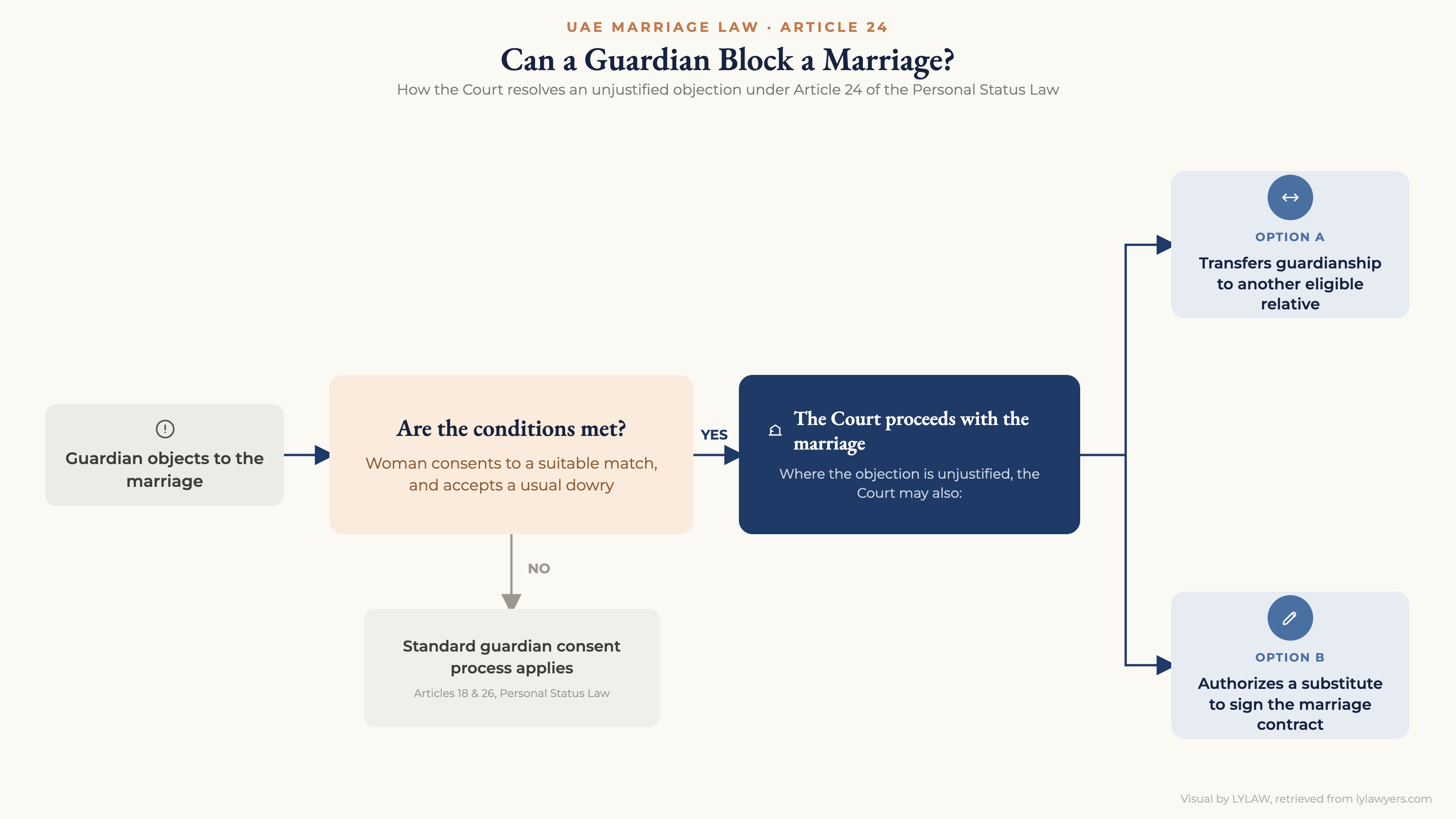
No, a guardian cannot block a marriage in the UAE once two conditions are met: the woman confirms she wants to marry a suitable match, and she accepts his dowry. Under Article 24 of the Personal Status Law, the Court proceeds with the marriage regardless of the guardian's objection at that point, even if the guardian is her father.
Article 24 states: "If the guardian, even if he is the father, prevents a woman over whom he has guardianship from marrying a man of her equivalence, and whom she has accepted, and with a usual dowry, the Court shall undertake the marriage of the woman at her request or the request of an interested party" (Federal Decree-Law No. 41 of 2024, Article 24, UAE Ministry of Justice legislation portal).
The Court's obligation applies once two conditions are met: the woman is satisfied she wants to marry the man, and she accepts his dowry. Guardian consent is otherwise a required element of a valid marriage contract for a Muslim bride: Article 18 lists the guardian as one of the contract's necessary elements, and Article 26 restates the same requirement as a condition of the contract's validity, subject to the Article 1(3) exception for a non-citizen bride whose home-country law does not require a guardian.
Several people can bring the request to the Court on her behalf, not only the woman herself:
- The prospective groom
- Her mother
- Her sister
- Her brother
Each is treated as an interested party under the law.
Where a guardian's refusal is unjustified, the Court has two further options: transferring guardianship to another eligible relative, or authorizing a different person to conclude the marriage contract in the guardian's place.
How Article 24 differs from the 2005 law
Is Article 24 the same as "court marriage" in the UAE?
No, Article 24 is not the same as "court marriage" in the UAE. Article 24 is how the Personal Status Court steps in when a guardian blocks a Muslim woman's marriage. "Court marriage" more often refers to something else: the civil marriage service run through the Abu Dhabi Civil Family Court, which does not involve a guardian, a religion requirement, or Article 24 at all.
Civil marriage in the UAE: who it's for, and what it costs
Civil marriage is a separate track from the guardian and court rules above, open to any two people regardless of religion, provided neither is a UAE national. It runs on two parallel regimes depending on the emirate.
Abu Dhabi runs its own service under Abu Dhabi Law No. 14 of 2021 on Civil Marriage and its Effects and its 2022 procedural update, Resolution No. 8 of 2022: both parties must be 18 or older, unmarried, and not closely related. The Abu Dhabi Judicial Department charges AED 300 for standard service, taking about two to three weeks, or AED 2,500 for express service, completed in as little as one working day. Neither a guardian's consent nor a witness is required.
Dubai and the other emirates process civil marriage for non-Muslims under a federal law instead, Federal Decree-Law No. 41 of 2022 on Civil Personal Status, which sets a higher minimum age of 21 for both parties. Dubai Courts can issue a civil marriage license within 24 hours.
Muslim non-citizens can use Abu Dhabi's civil marriage process too, an option the default Sharia-based rules in this article do not offer them. For the full document checklist and process, LYLAW's guide to marrying through the Abu Dhabi civil service covers each step in detail.
What is the minimum marriage age in the UAE?
The minimum marriage age in the UAE is 18 Gregorian years under the Personal Status Law. Article 19 prohibits registering a marriage contract for anyone younger, except with the Court's permission. Civil marriage runs on a different rule: 21, under the federal Civil Personal Status Law described in the civil marriage section above.
Article 19 states that a marriage contract cannot be documented for anyone who has not reached 18 Gregorian years, "except with the permit of the court and after verifying the existence of an interest in this marriage," following controls and procedures the Cabinet sets for marriages below that age (Federal Decree-Law No. 41 of 2024, Article 19).
Article 19 adds a second, unrelated restriction: where the bride is a virgin and the age gap between the couple is more than 30 years, the marriage cannot be concluded without the Court's permission either, regardless of both parties' ages.
The Cabinet resolution setting the specific procedural controls for underage marriage applications has not been published in full text. The requirements for a given case are worth confirming directly with the Court or a family lawyer before applying.
Do foreign residents need a guardian's consent to marry in the UAE?
Foreign residents do not automatically need a guardian's consent to marry in the UAE. Article 1(3) of the Personal Status Law lets non-UAE citizens apply their own country's law instead of the UAE's default rules. A Muslim woman whose home country does not require a guardian's consent can rely on that law instead of the UAE's Sharia-based default.
Article 1(3) states: "The provisions of this Law shall apply to non-UAE citizens unless one of them insists on applying his/her law or any other law that has been agreed to be applied, as permitted by the legislation in force in the State" (Federal Decree-Law No. 41 of 2024, Article 1(3)).
Without that request, UAE law applies to non-citizens by default too, including the guardian consent expectation for Muslim brides, though Article 24 already limits how far an objection can go.
Three situations non-citizen Muslim women commonly face
How the choice-of-law option plays out depends on which of three situations applies:
- She requests her home country's law, and that law does not require a guardian's consent. The UAE's guardian requirement generally will not apply to her marriage.
- She does not request an alternative law. The UAE's default rules apply, including guardian consent, though Article 24's court mechanism still limits an unjustified objection.
- She is in an interfaith relationship. Restrictions on Muslim women marrying non-Muslim men generally still apply regardless of which law she requests, because choice of law is subject to UAE public order.
The Court reviews every request to apply a foreign law and will not apply it where doing so would conflict with UAE public order. The outcome depends on the specific law involved and how well it is documented.
Documentation foreign residents need for a choice-of-law marriage
Applying home-country law instead of the UAE default calls for authenticated, translated proof of what that law requires:
- A certificate or legal opinion confirming the content of the home-country law
- A certified translation into Arabic
- Attestation through the usual chain: home country authorities, the UAE embassy, and the UAE Ministry of Foreign Affairs
The Court checks that content against UAE public order before accepting it. In LYLAW's experience, incomplete or unattested documentation is the most common reason these applications stall.
Marriage requirements beyond guardian consent
Age, guardian consent, and choice of law sit alongside requirements that do not change under Article 24:
- Pre-marital medical screening
- Dowry limits
- The registration method itself, a religious ceremony, a court appearance, or an online portal such as eZawaj
For the full checklist of documents and registration steps, LYLAW's guide on how Muslim couples register a marriage covers each route in detail.
What this means in practice
For UAE nationals and Muslim residents, a guardian's objection now carries far less weight than it did under the 2005 law, and the Court will act where that objection is unjustified. For foreign residents, the outcome depends on whether they request their own country's law and whether the Court accepts it as consistent with UAE public order, or whether civil marriage is a better fit for their situation. Anyone marrying under 18 under the default rules, under 21 for civil marriage, or facing a 30-year-plus age gap where the bride is a virgin, still needs the Court's separate permission regardless of any of the above.
These changes do not remove every guardianship or age requirement. UAE nationals do not have the choice-of-law option under Article 1(3), which applies only to non-citizens, and interfaith restrictions on Muslim women's marriages are not affected by any of the provisions above.
On guardian consent disputes, court-approved marriages, and choice-of-law applications under the Personal Status Law, LYLAW's family law team advises both UAE nationals and residents. Contact LYLAW to discuss how these rules apply to your situation.
This article provides general information only and does not constitute legal advice. The law and its application depend on individual circumstances and may change over time. For advice specific to your situation, please contact the LYLAW team.